Your Traffic Is Gone and It's Not Coming Back
Google organic traffic fell 15% across 16,661 sites in a year, and AI Overviews are why. What the clicks you keep are worth, and what to measure now.
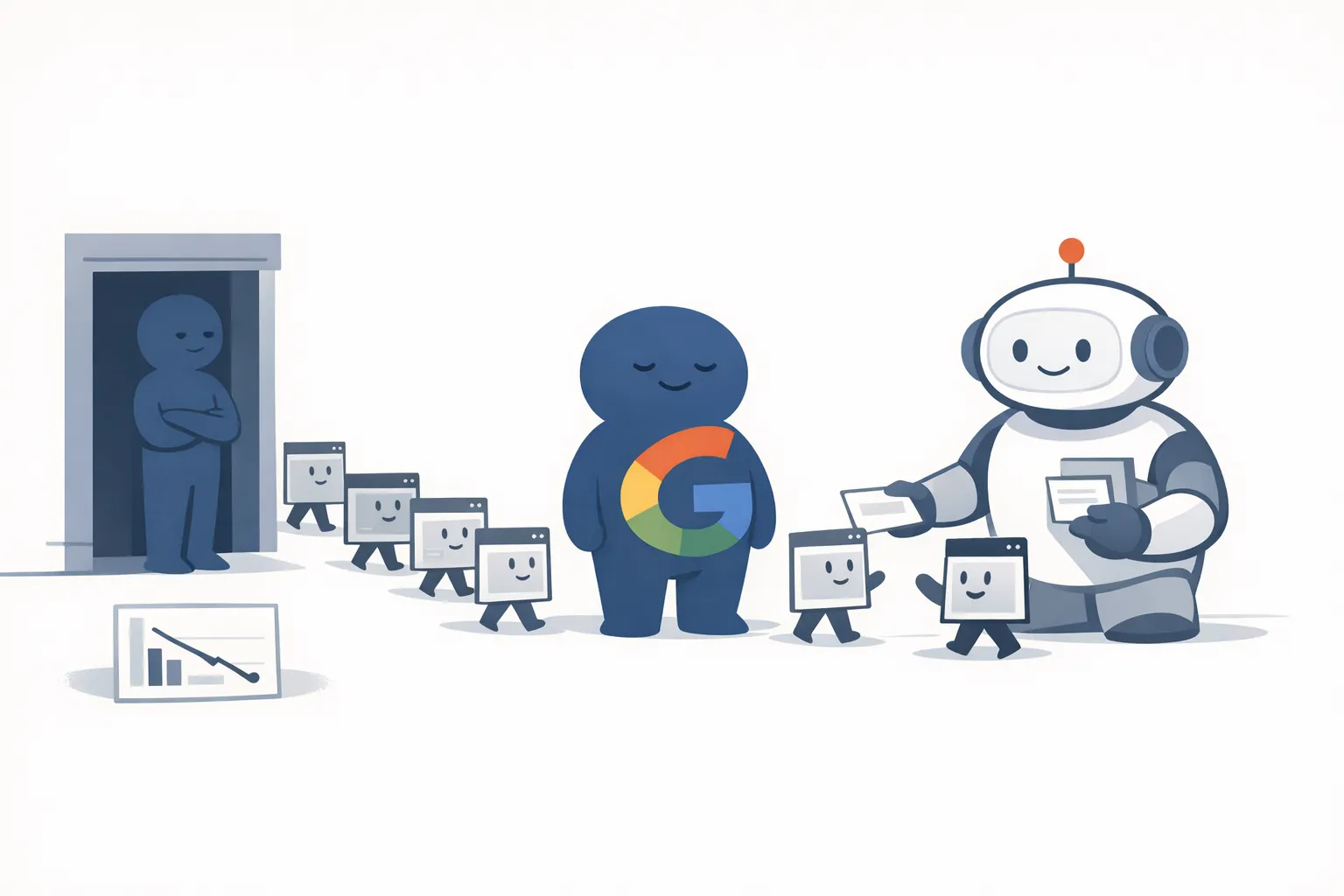
How much has organic traffic from Google fallen?
Organic traffic from Google fell 15.0% in a year across a fixed cohort of 16,661 websites: Google sent them 3.16 billion organic clicks in the year to August 2026, down from 3.72 billion in the year before. Organic traffic is the visits a site earns from unpaid search results, and it is still the first line of most B2B marketing reports.
That is the headline of SEOcrawl’s study of more than 16,000 sites, built from the Google Search Console and GA4 data of sites connected to its platform, with the same sites measured in both years. The median site lost 20.1%. Sixty-nine percent of the 16,661 sites lost traffic. And the organic traffic decline sped up: the year-over-year drop was 7.5% in May 2025 and 21.8% by August 2026.
If your organic traffic is down this year, you are in the majority. A flat line in 2026 is an above-median result, and a report that grades this year’s sessions against 2024’s is grading you against a market that no longer exists.
The sites that look most like a B2B company’s blog took it hardest. Sites earning 1,000 to 10,000 Google clicks a month lost a median 28%, and 78% of them declined. SaaS and tech sites lost 24%.
My own site shows the same shape at a smaller scale in Google Search Console. In the 28 days ending November 7, 2026, Google showed drewgarrett.org 47,666 times, up 31% from 36,259 in the 28 days before. Clicks were 102 in both periods. A third more visibility bought zero more visits.
Is the drop in organic traffic your site or the market?
Search Console impressions tell you whether the drop is your site or the market. If impressions fell along with clicks, you lost rankings, and that is a fixable problem with its own diagnosis for a drop in organic traffic. If impressions held or rose while clicks fell, you are looking at the Great Decoupling, and no change to your site brings those clicks back.
Why is organic traffic declining?
Organic traffic is declining because Google now answers the question on the results page, and a searcher who already has the answer has no reason to click.
The cleanest proof is a randomized field experiment run in early 2026. Researchers Agarwal and Sen, of the Indian School of Business and Carnegie Mellon University, ran a pre-registered study on 1,065 US desktop Chrome users from January to February 2026, hiding AI Overviews for some participants and leaving them in place for others (Search Engine Journal’s summary covers the design). Where an AI Overview appeared, organic clicks fell 38%. Searches that ended with no click at all rose from 54% to 72%. Clicks on ads did not change, and neither did how satisfied people were with their results. That is causation, measured: the Overview itself takes the click.
Pew Research Center tracked the browsing of 900 US adults in March 2025 and found the same behavior outside a lab. People clicked a traditional result on 8% of visits when an AI summary appeared and on 15% when none did. They clicked a link inside the summary on 1% of visits. And 26% ended their browsing session on a results page with a summary, against 16% on one without.
How much do AI Overviews cut click-through rates?
Organic click-through on queries that show an AI Overview fell by more than half during 2025. Seer Interactive’s tracking across 53 brands and 5.47 million queries shows organic click-through on queries with an AI Overview falling from 3.19% in January 2025 to 1.31% in December 2025, then recovered to 2.36% by February 2026, still well under the 3.82% on queries with no Overview. Being cited inside the Overview helps: cited pages earned 120% more clicks per impression than uncited ones. Even so, they earned 38% fewer clicks than pages on results with no Overview at all. Winning the citation is worth the work, and it still leaves you short of the clicks you used to get.
None of this started with AI. Zero-click search was already common thanks to featured snippets and knowledge panels, and SparkToro’s analysis of Similarweb panel data puts it at about 68% of US Google searches from January to April 2026. AI Overviews made it the default for any question with a settled answer: BrightEdge found them on about 48% of tracked queries across nine industries in February 2026, up from about 31% a year earlier.
Will organic traffic come back?
No. Informational organic traffic is not coming back to its 2024 level, because Google has no reason to reverse the change and every measure of it was still getting worse through August 2026.
The searcher got the answer, rated it just as highly, and never needed your page. Nothing in that sentence is going to reverse.
- Searchers don’t miss the click. In the field experiment, people rated results with an AI Overview as highly as results without one. A product change that users like is not a change Google rolls back.
- Ads keep their clicks. Sponsored clicks held steady while organic clicks fell 38%. The change costs publishers and leaves Google’s ad revenue alone.
- The decline is steepening. SEOcrawl’s cohort went from −7.5% year over year in May 2025 to −21.8% in August 2026. A trend that gets worse every quarter is not near its floor.
- The rebound Seer saw is partial. Click-through on AI Overview queries climbed from 1.31% to 2.36% in early 2026, which still sits well below the 3.82% on queries with no Overview, and Seer says it cannot yet explain the recovery.
- AI assistants don’t refill the gap. AI referrals grew 44.6% year over year in SEOcrawl’s GA4 data from 3,949 sites, and they still delivered 1.25 visits for every 100 from Google (1.52 in August 2026). At that ratio, AI referrals would need to grow more than tenfold just to cover the visits Google stopped sending in one year. SEOcrawl calls its AI number a floor, because traffic from AI apps often loses its referrer, and even generous undercounting leaves a gap of that size.
It is the same thing I tell every account I run: plan for informational clicks to keep falling, and build the budget around the clicks that remain.
What does Google say about the drop in organic traffic?
Google says organic traffic is stable and publishes no data to show it. In August 2025, Google’s head of Search, Liz Reid, wrote that “total organic click volume from Google Search to websites has been relatively stable year-over-year” and that Google is sending “slightly more quality clicks.” No numbers sit behind either statement. SEOcrawl’s cohort was already down 7.5% year over year in May 2025, three months before that post. Between an unpublished assertion and 3.72 billion measured clicks, I’ll take the measured clicks.
Is SEO dead?
No. SEO is how a brand gets found on Google, which still sent roughly 80 visits for every one from an AI assistant in SEOcrawl’s data, and in the AI assistants themselves, which build answers from pages that rank for the searches they run. Those are often not the searches you track: Ahrefs found in March 2026 that only 38% of pages cited in AI Overviews rank in Google’s top 10 for the same query, down from about 76% in July 2025, and it attributes the shift to Google fanning one question out into many sub-searches. What died is the exchange rate. A ranking used to buy a predictable number of visits, and in 2026 it buys far fewer.
People who say SEO is dead are usually describing a traffic chart. Look at the same accounts through pipeline and the picture flips.
Does SEO still work?
Yes, SEO still works when you judge it on pipeline, and the 2026 numbers from B2B SaaS accounts I run and ran show traffic and demand moving in opposite directions.
On a cybersecurity SaaS account, organic clicks fell 32% in one quarter, from 53,000 to 35,874, while organic opportunities rose from 37 to 43. On an HR-tech SaaS account I ran until September 2026, organic sessions fell 52% in the first half of 2026 while organic MQLs reached 116% of goal, up 22% year over year. Qualified meetings on that account lagged at 63% of goal, a sales-conversion problem a traffic report would never have surfaced. Both programs would have been cut on a traffic dashboard. Both were producing more qualified demand while the traffic chart said they were failing.
If you want the full method for that judgment, how to tell if SEO is working walks through it, and will AI replace SEO covers what the change means for the people doing the work.
How much is the organic traffic you keep worth?
The organic traffic you keep is worth more per visit than the traffic you lost, because the clicks that remain come from people close to a decision.
A marketing-tech SaaS account shows how concentrated that value has become. Across 21,068 non-brand queries in July 2026, positions one to three turned impressions into clicks at 1.01%. Positions four to ten turned them into clicks at 0.06%, and positions 11 to 20 at 0.05%. Page one, outside the top three, now behaves like page two.
The account’s category head term moved from position 14.8 to 4.2 that month. Impressions rose from 56,970 to 656,483. Clicks went from 12 to 32. A ranking jump that once would have been a traffic event produced twenty extra visits. On that account I retired “page one” as a success measure on commercial terms and made the top three the target, a change that “will reduce the number of wins we report while increasing the value of each one.”
AI referrals run the other way: small volume, high value. Across the accounts I run, a visitor who arrives on an AI recommendation converts at roughly four times the rate of a traditional organic click. Adobe’s analysis of more than 1 trillion visits to US retail sites shows the same direction at retail scale: in September 2026, AI-referred visitors generated 83% more revenue per visit than non-AI visitors and converted at a 90% higher rate. In August 2025, AI traffic converted 9% worse. In one year the AI visitor went from tire-kicker to the best-qualified visit on the site, because the assistant did the comparing before the click.
That splits the job in two. An informational page earns its keep by being the source an AI answer names. A commercial page earns its keep by ranking in the top three and converting a visitor who arrives already half decided.
What should you do when organic traffic declines for good?
When organic traffic declines for good, rebuild your SEO strategy around the visits and mentions that still produce pipeline. These are the changes I make on accounts where the drop traces to the market.
Make pipeline the headline SEO metric
Move sessions to the diagnostic tab and put organic opportunities, MQLs, or revenue at the top of the report. On the HR-tech account above, the north-star metric stayed on MQLs through the traffic drop, with meetings tracked as the quality check, so a 52% session decline read as a demand result (MQLs at 116% of goal) with a sales-conversion gap behind it. A legal SaaS program measured in demos shows what that reporting looks like when the work lands: organic sessions rose 63% in six months, and the number that justified the budget was 362 organic-influenced demos, which made organic the largest influenced-demo channel. To tie organic search to revenue, start with how to measure SEO ROI.
Target the top three positions on commercial terms
Positions four to ten on a buying query collect impressions, and positions one to three collect the clicks. Pick the commercial terms where a top-three position is realistic and concentrate there. The bottom-of-funnel keywords a buyer types near a decision are the first list to build.
Build the pages buyers still click
Comparison pages, alternatives pages, pricing, integrations, and use-case pages are where clicks held across my accounts in 2026. On the cybersecurity account, a refreshed EDR comparison page grew every month of the quarter the account lost 32% of its clicks, from 106 to 137, and new vendor-comparison pages entered at positions four to six. AI Overviews take top-of-funnel clicks and spare bottom-of-funnel ones because a buyer comparing vendors needs the specific page.
Track whether AI answers name your brand
Pick a fixed set of buying prompts, run them in ChatGPT, Google AI Mode, Gemini, and Perplexity on a schedule, and record two results for each: whether the answer names your brand and whether it cites your site as a source. The most-cited brand is often not the most-named one, so track both. I run this in Searchable. An AI visibility baseline is the number that replaces rankings for this half of search. How to choose an AI visibility tool covers the features that matter before you buy one.
Earn the sources AI answers cite
Across six B2B SaaS accounts, 88.7% of the sources AI answers cited were independent third parties, and 2.6% were the brand’s own site. Your pages are a small slice of what an assistant reads about you. Review sites, analyst coverage, Reddit threads, YouTube, and trade press make up most of it, which is why earned media now belongs in an SEO budget.
Give AI traffic its own channel in GA4
GA4 has done this by default since May 2026: its AI Assistant channel collects referrals from assistants such as ChatGPT, Gemini, and Copilot, so those visits no longer hide inside Referral, and a custom regex channel is no longer needed. Google’s AI Overviews and AI Mode stay in Organic Search. Treat the number as a floor. Visits from AI apps often arrive with no referrer and land in Direct, so a rising Direct line on your commercial pages is partly AI.
Keep the informational content AI can’t write
Generic explainers are the pages AI Overviews replace first. Keep the informational pages that carry something an engine cannot synthesize, like first-party data or a tested opinion, and prune the rest. Information gain is what earns the citation once the click stops coming.
Your traffic is gone. Your buyers are still searching, and more of them ask an assistant first. The program that holds up is the one that shows up in both places and counts what those buyers do next. That rebuild, from the prompt-set baseline to the source map to the reporting change, is the work in my generative engine optimization services.
FAQ
What does organic traffic refer to?
Organic traffic refers to the visits a website earns from unpaid search results on Google, Bing, and other search engines. Paid ads, referrals, social, and email are counted separately. In GA4 organic traffic appears as the Organic Search channel, and Google Search Console reports the same visits as clicks. For a B2B SaaS team in 2026 it is also the metric most likely to mislead, because an AI Overview can answer a buyer’s question, and shape the shortlist, without producing a single organic visit.
Why is my organic traffic down when my rankings are up?
Your organic traffic is down while rankings are up because AI Overviews and other answer features take the click on the results page, so a better position earns impressions that no longer turn into visits. In Search Console it shows as impressions and average position improving while clicks fall, and AI Overview impressions in Search Console explains how those impressions get counted.
How much traffic do AI assistants send to websites?
AI assistants send about 1.25 visits for every 100 from Google organic search, based on SEOcrawl’s GA4 data from 3,949 sites, rising to 1.52 in August 2026. ChatGPT accounts for 83.3% of that AI traffic. The real figure is somewhat higher, because app traffic often loses its referrer and gets counted as Direct.
Is AI traffic worth more than Google traffic?
Per visit, yes. Across the accounts I run, AI-referred visitors convert at roughly four times the rate of a traditional organic click, and Adobe measured 83% more revenue per visit from AI referrals on US retail sites in September 2026. In total, Google still delivers far more value, because it sends roughly 80 times the visits.
Does SEO still matter?
Yes. SEO still matters because Google remains the largest source of discovery on the web, and AI assistants build their answers by running searches of their own (Google calls it query fan-out) and reading the pages that rank for them. Asking “is SEO still relevant” for a given search is really asking about intent: definitional questions now resolve on the results page, while comparison, pricing, and vendor searches still send buyers to websites.
Is SEO dying?
SEO is shrinking as a source of traffic and growing as a source of influence. The work that existed to collect informational clicks is fading. The work that decides which brands Google ranks in the top three and which brands AI assistants name matters more every quarter.
Should I cut my SEO budget if organic traffic is down?
Cut the spend that buys informational traffic and keep the spend that produces pipeline. Before you cut, check whether organic opportunities or MQLs fell along with sessions, and whether impressions fell. If pipeline and impressions both held, the program is working in a smaller traffic market, and cutting it hands the remaining buyers to a competitor. The SEO ROI calculator shows whether the program still pays back at today’s session count.
What changed
- November 19, 2026: Added Ahrefs data on which pages AI Overviews cite, SparkToro and BrightEdge figures on zero-click search, Google's own claim about organic clicks, and a definition of organic traffic.