AI Overviews Are Eating Your TOFU, Not Your BOFU
AI Overviews gut top-of-funnel clicks while bottom-of-funnel traffic holds or grows. Proof: one folder up 27% in BOFU clicks while the whole site fell 26%.
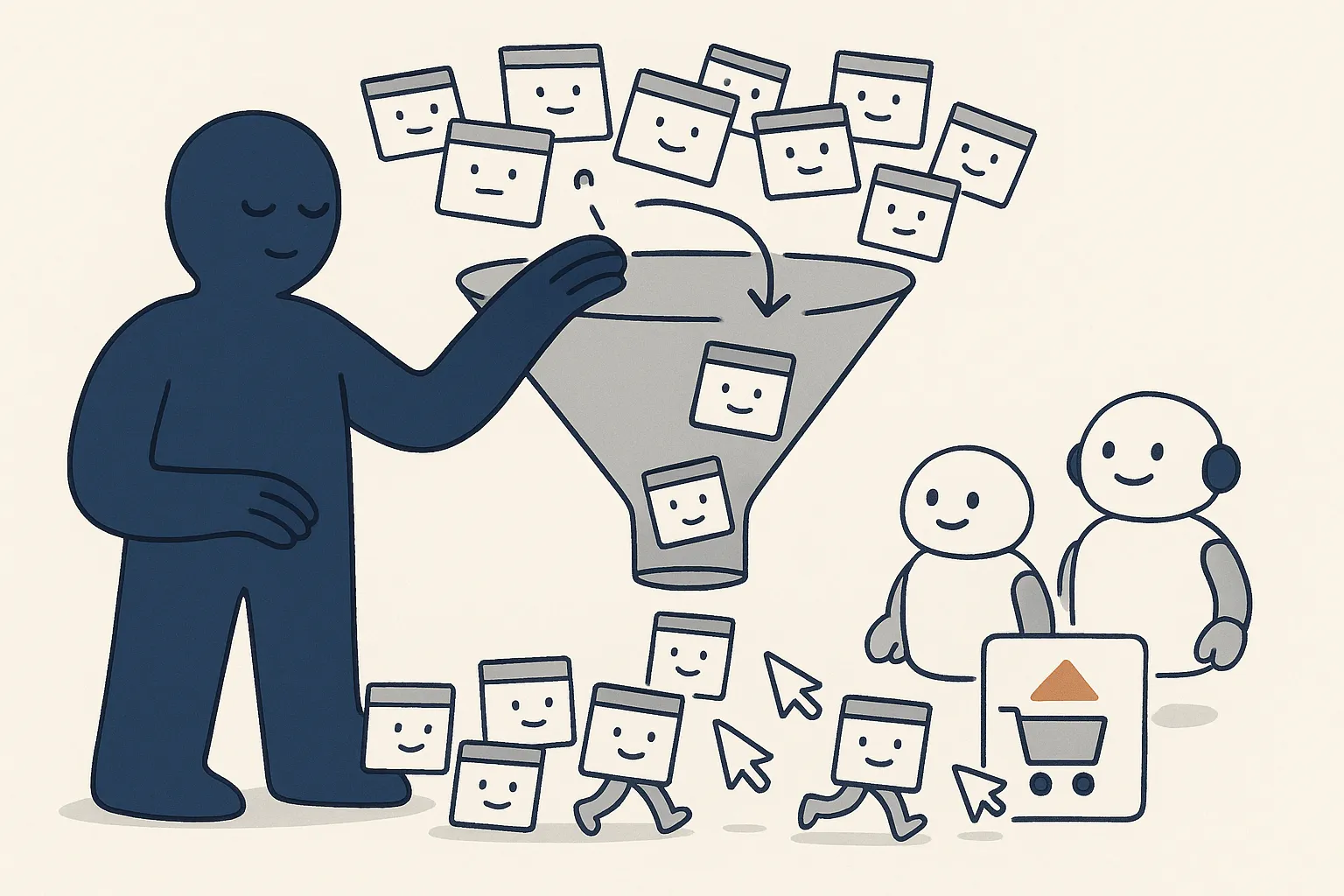
AI Overviews are eating the top of the funnel
Bottom of funnel SEO is the part of search that still sends you the click, and the anchor of any serious generative engine optimization plan. The AI Overviews top-of-funnel hit is real, but it stops there: while branded and top-of-funnel traffic erodes as AI Overviews answer the question on the results page, high-intent commercial queries keep converting, because a buyer who is close to a purchase wants to see the page itself. That gap is the most reliable pattern I see across five B2B SaaS accounts, and it is the single best argument for where to put content budget right now.
The shape of the AI-search shift makes this predictable. AI Overviews now appear on roughly 48% of queries and about 68% of US Google searches end without a click (SparkToro, early 2026), but those losses are concentrated where the answer is a fact or a definition. The closer a query gets to a buying decision, the less a one-paragraph summary satisfies it, and the more the searcher still clicks through to compare, price, and verify before spending money.
Top of funnel is where AI Overviews eat your clicks. Bottom of funnel is where buyers still insist on the page.
So bottom of funnel SEO is not a tactic that happens to be holding up. It is the place the decoupling has not reached, and the place demand is concentrating as the rest of the funnel goes zero-click.
Winning the answer on informational queries while protecting commercial pages is the goal of my answer engine optimization services.
What bottom of funnel SEO actually is
Bottom of funnel SEO, or BOFU SEO, is optimizing for the queries a buyer searches when they are close to a decision. The intent is commercial: the searcher is evaluating, comparing, and pricing. Get the page in front of that searcher and the click is worth far more than a top-of-funnel visit, because the visitor is already shopping.
In practice, bottom of funnel pages cluster into a handful of types:
- Comparison and “vs” pages: “[Tool A] vs [Tool B],” for buyers down to a shortlist.
- Alternatives pages: “alternatives to [incumbent],” for buyers actively leaving a tool.
- “Best [category] for [segment]” pages: the qualified version of a best-of list, narrowed to a specific buyer.
- Pricing and ROI pages: the queries that only a near-purchase searcher runs.
- Integration and use-case pages: “[product] for [specific workflow],” matching a buyer with a concrete job.
Top of funnel is the opposite end: “what is [category],” definitions, and broad how-tos. That content is exactly what an AI Overview reproduces best, which is why it is bleeding clicks. The funnel stage is what predicts whether a page still earns the visit.
| Top of funnel | Bottom of funnel | |
|---|---|---|
| Query intent | Learning a category | Evaluating a purchase |
| Page types | ”What is X”, definitions, broad how-tos | Comparisons, alternatives, pricing, “best X for [segment]“ |
| AI Overview impact | Absorbed, answered on the results page | Holds, the buyer still clicks to verify |
| Where the budget goes | Spending into the headwind | Build here; measure by influenced pipeline |
The proof: BOFU clicks up 27% while the site fell 26%
The cleanest version of this pattern I have on file: a cybersecurity SaaS folder that was up 27% in bottom-of-funnel clicks over the quarter while the overall site was down 26% in the same window. Same domain, same quarter, two halves of the funnel moving in opposite directions. The decline was real and concentrated in informational content; the commercial folder grew.
Same domain, same quarter, two halves of the funnel moving in opposite directions.
That is not a one-month fluke, it is the most-repeated proof in my entire dataset. The same split shows up month after month across multiple accounts: branded and TOFU clicks slide while BOFU clicks climb or hold. It is consistent enough that I now read a falling site-wide traffic line as a question to investigate, and the first thing to check is whether the loss is TOFU erosion masking BOFU strength underneath. The same resilience is what made organic the largest demo channel on a legal SaaS account, and it sat right alongside the cybersecurity gains that came from systemic on-page work.
High-intent buyers are still searching. The funnel did not collapse, it concentrated at the bottom.
Nine months later the commercial set on that account tells the same story with more resolution. From the May low to September 2026, the client’s priority commercial keywords went from 17 to 29 in the top 10, with 11 in the top three. Nine of them were cited as Google’s AI Overview answer, nearly all served by the account’s educational hub pages. AI Overviews do fire on commercial terms; the win there is being the page the answer is built from. Three terms slipped in the same window, and I keep a list of what fell out of the top 100 in my own notes, because a commercial set reported without its losses overstates the result.
The “so what” is a budgeting decision. If your overall traffic is down and you respond by pouring effort back into the TOFU pages that are losing clicks to AI Overviews, you are spending into the headwind. The folder that grew 27% is telling you where the wind is at your back.
Why bottom of funnel survives AI Overviews
Bottom of funnel SEO survives because AI Overviews are good at the questions buyers ask early and bad at the ones they ask late. An AIO can define a category, list the options, and summarize a how-to, and for those queries the searcher is satisfied on the page and never clicks. But “which of these should I actually buy for a regulated mid-market security team” is a judgment, and a judgment about spending money is one buyers want to confirm on a real page before they commit.
There is a second reason, and it is where bottom of funnel ties into getting named in the AI Overview. As AI answers increasingly recommend a specific brand for a specific need, the BOFU page that states a clear, defensible verdict is the one the model has reason to name. A generic feature roundup gets summarized away; a page that says which tool wins for which buyer, with proof, is both what the human wants and what the model surfaces. Bottom of funnel content is naturally the most opinionated content you own, which is exactly the coverage-to-perspective quality that earns the citation now.
This is the practical flip side of the Great Decoupling. The decoupling says impressions hold while clicks fall, on average. Bottom of funnel SEO is where that average breaks in your favor, because the click that matters most is the one a buyer refuses to skip.
Which bottom of funnel pages to build first
Prioritize the pages closest to a purchase decision, because that is where both the resilience and the revenue are. The sequence I use:
- Comparison and alternatives pages for your real competitors. A buyer searching “[competitor] alternatives” is mid-switch. These catch the highest-intent traffic there is and tend to convert fastest.
- “Best [category] for [specific segment]” pages. Narrow the best-of format to a buyer you can actually win, and give it a clear verdict, so it earns the click and the AI mention.
- Pricing, ROI, and use-case pages. The queries only near-purchase searchers run, and the ones least likely to be satisfied by a summary.
For every one of them, the rule is a defensible point of view plus first-party proof. A BOFU page that just lists features competes with an AI engine that lists features better. A BOFU page that takes a position a model cannot synthesize is the one that survives.
How to measure bottom of funnel SEO
Measure bottom of funnel SEO by influenced pipeline, because the entire point is that these are fewer, higher-value clicks. A TOFU traffic number can fall while BOFU quietly drives more demos than it did last quarter, and a sessions dashboard will tell you the opposite of the truth. Segment your reporting by funnel stage so the BOFU strength is not buried inside a declining site-wide line, and tie the commercial folder to demos and pipeline the way I lay out in how to measure SEO ROI.
The filter I use is a regex on the query in Search Console. Under Performance, add a query filter, choose Custom (regex), and match the modifiers buyers type near a decision, for example platform|software|tool|program|provider. Adjust the list to your category, keep it fixed so every period compares like with like, and report that line on its own next to the sitewide one.
Watch for one-page dependency when you do. On the cybersecurity account, most of the bottom-of-funnel clicks ran through a single tools comparison page. When that page slid, the account lost 386 clicks in a month and the BOFU line fell with it. A segment that leans on one URL needs that URL refreshed on a schedule.
The discipline is simple to state and easy to skip: track BOFU and TOFU separately, judge BOFU on revenue influence, and let the site-wide click number be the noisy thing it has become. The folder that bucks the trend only looks like a win if you are measuring at the resolution where the trend splits.
FAQ
Do AI Overviews hurt bottom-of-funnel pages?
Mostly no, and that is the whole thesis. AI Overviews hurt the pages whose value was a fact or a definition a model can restate for free, which is top-of-funnel content. A bottom-of-funnel page, a comparison, a pricing page, an “alternatives” verdict, serves a buyer who wants to click through and verify before spending money, so the summary does not satisfy the intent. Across five accounts, BOFU clicks held or grew while site-wide clicks fell, which is exactly why AI Overviews hurt the top of the funnel far more than the bottom.
Which content do AI Overviews affect most?
The content AI Overviews affect most is commodity informational content: “what is,” “how does,” and definitional queries where a one-paragraph answer is enough. That is where impressions stay high but clicks collapse. The content they affect least is high commercial-intent, decision-stage material, because the closer a query sits to a purchase, the less a paraphrase substitutes for the page.
What is bottom of funnel SEO?
Bottom of funnel SEO, or BOFU SEO, is optimizing for high commercial-intent queries from buyers close to a purchase: comparisons, alternatives, pricing, and “best [category] for [segment]” searches. It contrasts with top-of-funnel SEO, which targets early-stage informational queries. BOFU traffic is fewer clicks but far higher value, and in the AI-search era it is the traffic that holds up while informational clicks fall to AI Overviews.
What is BOFU content?
BOFU content is content built for the decision stage: comparison and “vs” pages, alternatives pages, pricing and ROI pages, qualified “best for [segment]” pages, and integration or use-case pages. The defining trait is that it serves a buyer who is evaluating, and the best of it carries a clear verdict and first-party proof.
What are bottom of funnel keywords?
Bottom of funnel keywords are commercial-intent search terms that signal a near-purchase mindset: “[competitor] alternatives,” “[tool A] vs [tool B],” “[category] pricing,” and “best [category] for [specific use case or segment].” They have lower search volume than top-of-funnel terms but much higher conversion value, which is why volume is the wrong way to judge them.
Does SEO still work with AI Overviews?
Yes, but unevenly. Top-of-funnel informational SEO is losing clicks because AI Overviews answer those queries on the results page, while bottom of funnel SEO still earns the click because buyers verify decisions on real pages. On one cybersecurity account, the commercial folder grew 27% over a quarter in which the overall site fell 26%. SEO works; it just pays at the bottom of the funnel now.
What part of the funnel is SEO?
SEO spans the whole funnel, but its value is shifting toward the bottom. Top-of-funnel SEO drives awareness and is the part most exposed to zero-click AI Overviews. Bottom-of-funnel SEO drives decisions and is the part still sending high-value clicks. The smart move in an AI-search world is to weight effort toward the BOFU end, where demand and resilience both concentrate.
How do you measure bottom of funnel SEO?
Measure it by influenced pipeline and demos, and segment BOFU from TOFU so a falling site-wide line does not hide the commercial strength underneath. Bottom of funnel pages produce fewer but higher-value visits, so a revenue-influence metric tells the real story where a traffic count misleads.
What are the stages of the marketing funnel?
The classic model is top of funnel (awareness, broad informational queries), middle of funnel (consideration), and bottom of funnel (decision, where buyers compare and buy specific tools). For SEO in 2026 the meaningful split is simpler: top-of-funnel informational content that AI Overviews now absorb, and bottom-of-funnel commercial content that still earns the click. Weight your effort toward the bottom.
What changed
- October 1, 2026: Added how a cybersecurity commercial set grew from 17 to 29 top-10 terms with nine AI Overview answers, the Search Console filter I use to track bottom-of-funnel clicks, and a warning about one-page dependency.
- September 29, 2026: Tightened the writing throughout and linked the related service page.