The Great Decoupling: impressions up, clicks down
The Great Decoupling is real: AI Overviews push impressions up while clicks fall. Cross-vertical client data, and what to optimize for instead.
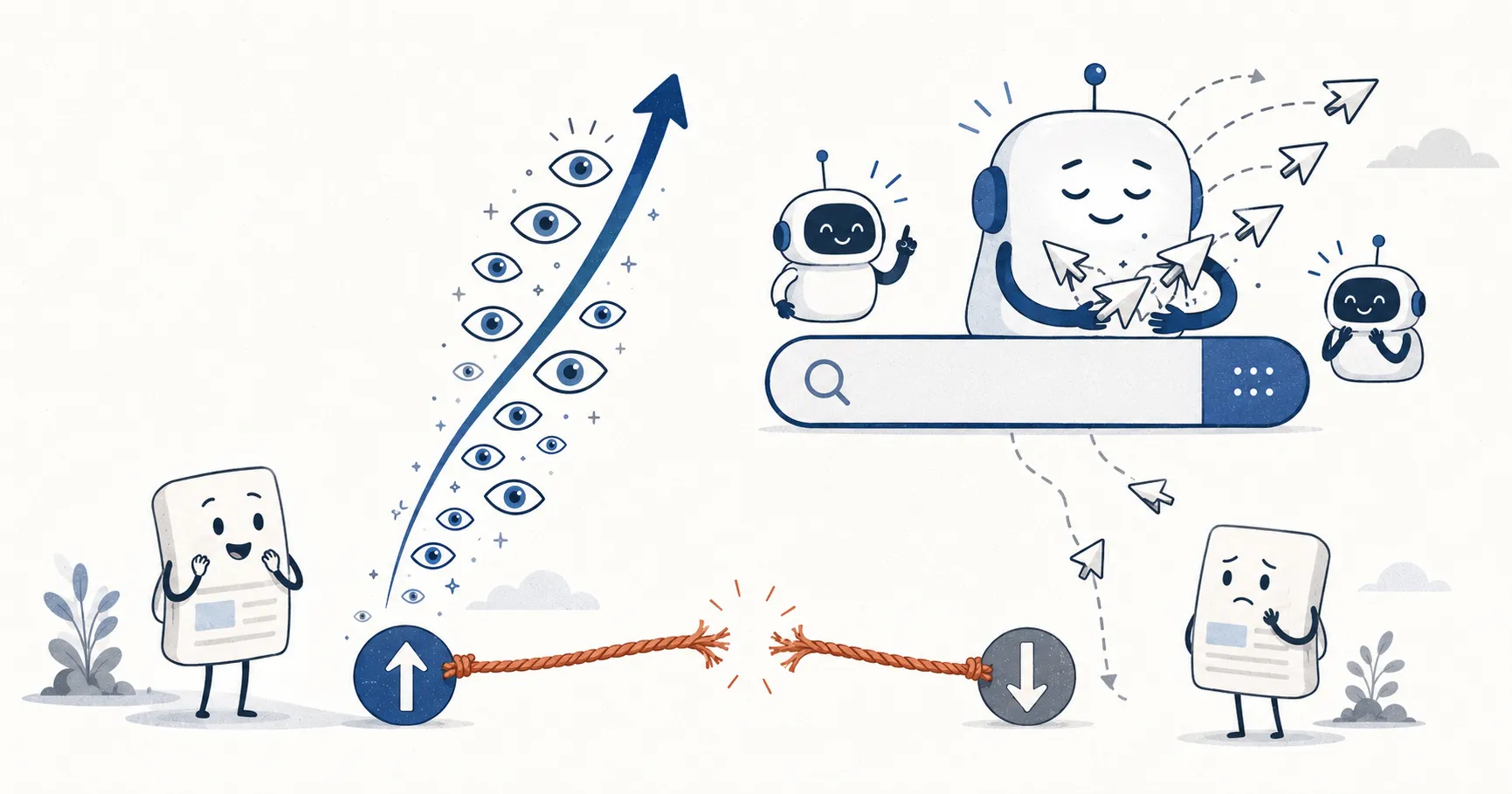
What the Great Decoupling actually is
The Great Decoupling in the economics sense is about pay and productivity; the great decoupling SEO version I mean here is narrower and newer: your impressions and your clicks have stopped moving together, the clearest symptom of why generative engine optimization exists. Ask yourself one honest question: when did you last Google something, click a blog result, and read the whole thing? It barely happens anymore. You search, you skim the AI Overview at the top, you get your answer, and you close the tab. Or you skip Google entirely, open ChatGPT, ask a specific question, and follow up right there. The behavior has changed, and you can feel it in your own habits.
There is one reliable exception. You click through when you are about to make a decision: when you are shopping, comparing, or buying, or when something genuinely fresh and first-hand catches your eye on a topic you actually care about. That is the click that still survives.
Multiply that instinct across billions of searches a day and you get the Great Decoupling. Open Google Search Console, set the date range to the last sixteen months, and look at the four metrics on one chart. For a lot of sites the two lines have come apart: impressions climb, average position improves, and clicks flatten or fall. The historic link between showing up in search and getting the click has broken.
For twenty years those two moved together. Rank higher, earn more impressions, collect more clicks. You could reason about one from the other. That assumption is dead. A page can rank better than it ever has and send less traffic than it did a year ago, at the same time, on the same query.
The cause is not mysterious. Google now answers the query on the results page. AI Overviews, the expanded snippets, the People Also Ask accordions: the searcher reads the answer and never clicks through. You still earned the impression. You did not earn the visit. Impressions up, clicks down, and the two no longer explain each other.
Why it is happening: the zero-click results page
Three forces are pulling the lines apart, and they compound.
The first is AI Overviews. They now trigger on roughly 48% of tracked queries, up from about 31% a year earlier, and they sit above the organic results with a synthesized answer assembled from several sources. When the answer is on the page, the click is optional.
The second is the zero-click results page in general. The zero-click rate hit about 65% in 2026. Featured snippets, knowledge panels, and instant answers already trained users not to click for a decade. AI Overviews finished the job. Average organic click-through on informational queries is down roughly 18% year over year, and on queries where an AI Overview fires the worst-case drop runs closer to 47%.
The third is instrumentation noise stacked on top of the real shift, mostly the removal of the num=100 search parameter, which changed how rank trackers and Search Console count impressions. That one is a data artifact, not lost demand, and it gets its own treatment below. The point for now: most of the decoupling is real, and a slice of it is measurement. You have to separate them, not lump them.
None of this is a glitch, and none of it is a penalty. It is the search experience working as designed in 2026. The honest framing, the one I have repeated to every account I run: expect informational clicks to keep falling and not come back once a new search experience fully rolls out. Plan around it instead of waiting for it to revert.
What it looks like in the data
Here is the cleanest single chart I have for it. On one B2B SaaS account, in a single month, impressions rose by more than 650,000, average position improved from 17.1 to 12.6, and clicks fell by about 7,100. Every visibility metric a 2021 SEO report would celebrate went up. The one metric that pays went down.
Avg. position 17.1 → 12.6. Ranked better, fewer clicks.
If you were managing that account on sessions alone, you would file it as a bad month and start cutting. If you understand the decoupling, you read it correctly: Google is showing the site far more often, ranking it materially better, and intercepting a chunk of the resulting clicks on the results page. The visibility is real. The traffic model is what changed.
That is the whole argument in three numbers. The work is teaching a CMO to see it that way too, because the instinct is to panic at the clicks line and miss the two lines above it.
The pattern repeats across verticals
One account could be a fluke. It is not. The same shape shows up across every B2B SaaS vertical I work in, and it is specific, not vague: top-of-funnel erodes while bottom-of-funnel holds or grows.
On an HR-tech account, the informational content took the hit exactly where you would expect. A pair of broad top-of-funnel pages, the kind that answer a general question anyone can ask a chatbot, lost more than 6,800 and 3,100 clicks in a single month. Those are textbook AI Overview casualties: general-knowledge queries where the model can answer without a source. In the same window, the bottom-of-funnel pages, the high-intent commercial queries, held their clicks. Buyers comparing platforms and pricing still clicked through, because they needed the specific page, not a synthesized paragraph.
On a creator-tools account, the lost informational clicks did not just hold elsewhere, they reappeared on a different surface. LLM-referred sessions went from 11,639 in April to 52,786 in May, a 353.5% jump in a month, and paced toward roughly 134,000 in June. The traffic did not vanish. It migrated from blue links to AI answers, and the share that came back through ChatGPT and the rest converted, alongside a record month of organic subscriptions. As I put it in that account’s notes at the time: LLM sessions are more than making up for the loss in clicks. This is the future of search.
So the decoupling is not a uniform collapse. It is a redistribution. Commodity informational traffic, the stuff a model can answer on its own, is being absorbed into the results page. High-intent demand and AI-surface referrals are where the value moved. If your reporting only watches total organic clicks, you see a decline. If you cut the data by intent, you see the actual story.
Rule out seasonality, num=100, and a penalty first
Before you act, rule out the three things people mistake for the decoupling, because the wrong diagnosis leads to the wrong fix.
It is not always seasonality, but sometimes a dip genuinely is. The test is simple: if rankings are stable and impressions are down, that is usually a demand or seasonal pattern, not an SEO problem. I called a November dip on a legal SaaS account as a seasonal B2B budget freeze rather than erosion, and the year finished materially ahead. Stable rank plus falling impressions is demand. Falling clicks on rising impressions is the decoupling. Those are different problems.
It is not the num=100 removal, although that muddies the chart. When Google retired the num=100 parameter, rank trackers and Search Console started reporting fewer keywords and impressions, because a lot of phantom page-two-and-beyond data disappeared. That is an instrumentation change, not traffic you lost. Net it out before you read the trend, or you will attribute a reporting artifact to AI Overviews.
And it is not a penalty. There is nothing to appeal and nothing broken to fix. The page ranks fine. Google simply answered for it. Treating the decoupling as a technical emergency sends teams chasing canonicals and crawl errors when the real shift is in how answers are delivered.
What to optimize for instead
If clicks are no longer the unit that survives, stop building the strategy around them. Five moves, in order of leverage.
Make content for buyers, not for answers. This is the biggest change in what you actually produce. Top-of-funnel, pain-point, what-is content is exactly what an AI Overview or a chatbot now answers for free, so the clicks it used to earn are gone and not coming back. Put your content where people still click: bottom-of-funnel, decision-stage queries where someone is comparing, shopping, or buying, plus genuinely fresh, first-hand pieces worth reading on their own. It is the same instinct you have yourself. You click when you are deciding, not when you are idly curious. This shift is big enough to deserve its own piece, but it starts here: stop writing for the query a model will answer, and start writing for the buyer a model cannot close.
Report influenced pipeline, not sessions. The number that survives the decoupling is the one tied to revenue: demos, qualified opportunities, and influenced pipeline that organic touched. On a legal SaaS account, organic drove 362 influenced demos over six months, 29% of all demos and the single largest channel, on a fraction of the paid spend. Sessions fell in places that same year. Pipeline did not. Measure the thing the business actually buys.
Earn the AI answer, and get named in it. Being cited beneath an AI Overview is table stakes now, not the prize. The prize is having your brand named inside the answer, because a citation a user never reads does nothing for you. Structure content to be the thing the model pulls in: clear claims, first-party data, schema, a defensible position. Eligibility is on-site. Getting surfaced is the goal.
Win the click you do get. Fewer people will arrive, so conversion rate on the ones who do matters more than it ever did. CRO stops being a growth-team nicety and becomes the way you protect the value of a shrinking click stream.
Be mentioned across the web. LLMs synthesize from everywhere, not just your domain. If you are not showing up on LinkedIn, in the category roundups, on the third-party sites that AI answers pull from, the model has no reason to name you. Digital PR and mention share are now part of search, not a separate program.
The throughline is one shift in unit. Pageviews were a proxy for value when the click was the only way to reach a buyer. In a zero-click world the click is no longer the unit. The influenced buyer is. Optimize for the buyer, instrument for the AI answer, and the decoupling stops looking like a decline and starts looking like a map of where the value moved.
This is the lens behind everything else I write here. The format shift it forces on content, the reason thin pages now sit in crawled, currently not indexed, the migration of traffic to AI surfaces in the creator-tools LLM surge, the bottom-of-funnel resilience in the legal SaaS organic-growth work: all of it is the decoupling playing out. Start here, then read the rest through it.
FAQ
What is the Great Decoupling in SEO?
It is the breakdown of the long-standing relationship between impressions and clicks in Google Search. Historically, more impressions and better rankings meant more clicks. Since AI Overviews and the zero-click results page took hold, a site can gain impressions and improve its average position while clicks stay flat or fall, because Google answers the query on the results page instead of sending the visit.
Is the Great Decoupling the same as Google saying clicks went up?
No, and that is the confusion worth clearing. Google has pointed to its own aggregate data to argue clicks are healthy. On individual sites, especially content-heavy ones, the lived experience is the opposite: impressions and rankings up, clicks down. The aggregate and the site-level view are not the same chart. Trust the one in your own Search Console.
Does impressions up, clicks down mean my SEO is failing?
Usually the opposite. Rising impressions and improving average position mean Google is showing you more and ranking you better. The falling clicks are AI Overviews and the zero-click results page intercepting visits, not a drop in your SEO quality. This is the first thing to rule out when you are asking why your Google rankings dropped: confirm the position actually fell before you go hunting for a cause. Read the visibility metrics and the click metric as two different stories, then cut the data by intent before you judge it.
Is SEO dead because of AI Overviews?
No. The unit changed, not the discipline. Informational, top-of-funnel clicks are being absorbed into the results page. Bottom-of-funnel, high-intent demand still clicks through, and a growing share of traffic now arrives through AI surfaces like ChatGPT. SEO becomes the work of being the source the AI answer is built from and of capturing the high-intent demand that still converts.
How do I fix the Great Decoupling?
You do not reverse it, you adapt to it. Switch your reporting to influenced pipeline instead of sessions, structure content so your brand is named inside AI answers rather than merely cited, raise conversion rate to make every click you do get count, and build mention share across the web so LLMs surface you. The clicks you lost to the results page are not coming back. The value moved, and the strategy moves with it.