AI Citations Are a Vanity Metric
AI citations are a vanity metric. Why citation counts mislead, why tools log AI Overviews as position #1, and what to measure instead: brand-mention share.
AI citations are a vanity metric
Everyone is celebrating AI citations right now. A brand gets pulled into the source row under a Google AI Overview, someone screenshots it, and the dashboard ticks up another citation. Congratulations. It almost certainly did nothing for the business.
Here is the uncomfortable version, and I will say it plainly: a citation is not a recommendation. The AI answer writes a paragraph and then hangs a row of source links beneath it. The citation is the link. The recommendation is whether the synthesized text actually names your brand as the answer. Those are not the same thing, and counting the first while ignoring the second is how teams convince themselves they are winning while their pipeline goes nowhere.
A citation you cannot turn into a mention is a footnote. You did the work, and the AI handed the recommendation to someone else.
So I do not care whether my client’s page is the citation. I care whether the answer names my client as the one to buy. Citation count is a vanity metric. Brand-mention share is the real one.
Citations vs visibility: what is the difference?
Two words get treated as the same thing, and they are not. A citation is the source link an AI answer hangs beneath its response, the row of URLs under the paragraph. It says a model read your page. Visibility is whether your brand is actually named in the answer itself, across the prompts you track. You already know what a citation is. Visibility is the harder, realer thing: for the decision-stage questions your buyers ask, is your brand the name the answer gives, or the one it leaves out. A page can rack up citations and have almost no visibility, because being a source the model reads is not the same as being the brand it recommends. That gap is what the rest of this piece is about.
A citation is not a recommendation
Sit with the mechanics, because the whole confusion lives here. An AI Overview, or a ChatGPT answer, synthesizes a response from across the web and attributes some of it with source links. You can earn one of those links by being a page the model read. Useful, but not the prize. The prize is being the brand the sentence recommends, because that is the only part the reader actually absorbs.
This is the same trap the self-promotional listicle falls into. Of brands’ own “best” lists that got cited in a study of 100 B2B queries, the answer recommended a competitor 69% of the time. The page was the source. The competitor was the answer. You can be cited constantly and recommended never, and only one of those shows up in a buyer’s shortlist. The constructive how-to for closing that gap is its own piece, how to get named, not just cited. This one is about why you should stop scoring yourself on the wrong number first.
Most cited is not most named
Here is the proof that made this concrete for me, and it is the most counterintuitive data point I have. On an HR-tech account I run, the brand is the single most-cited domain in its entire category. Most cited. More than ten thousand AI and LLM citations, ahead of every named competitor in the space. By the metric everyone is celebrating, it is winning outright.
It is not the most visible. For the prompts a real buyer asks, it is frequently not the brand the answer names. It is the source the models read and a competitor is the brand the models recommend. The internal read on the account was blunt: the work now is to show up named, in as many places as possible, not to pile up more citations it already leads on.
That gap is the entire argument. Being the most-cited domain and being the named recommendation are different games. One feeds your ego and your slide deck. The other feeds your pipeline. If the most-cited brand in a whole category can still lose the recommendation, citation count is not measuring what you think it is.
You can be cited and still be invisible
The opposite shape proves the same point. On a cybersecurity account I run, I track brand mention across a set of decision-stage prompts a real buyer would ask. The brand surfaced in just 3% of tracked LLM responses. Two larger competitors sat at 26% and 21%.
The brand is cited plenty of places. It is also, in the answers that actually decide a deal, nearly invisible. A citation tally would have shown a healthy, rising number while the brand was being left out of the recommendation eight or nine times out of ten. That is a share-of-voice gap a citation count cannot see, and it is far wider than anything classic rank tracking would have shown, because on Google the same gap was a fraction of the size.
You can be cited everywhere and named nowhere. The citation count goes up while the buyer never hears your name.
What to measure instead: brand-mention share
Stop counting citations and start measuring whether your brand is named. The metric that matters is brand-mention share: across the prompts your buyers actually run, how often is your brand the named recommendation, which competitors are named instead, and does that movement tie to pipeline.
Tracking it well comes down to three things. First, the prompts. You are only ever as good as the prompts you track, so pick the decision-stage questions a real buyer asks, not vanity prompts you know you win. Second, named versus cited. For each prompt, record whether your brand appears in the answer text, not just the source row, and who got named in your place. Tools built for this (Scrunch, Profound, and the category around them) measure exactly that. Third, the tie to revenue. A mention only matters if it shows up downstream as influenced pipeline, the same unit that survives the rest of the zero-click shift. Mention share with no pipeline behind it is just a prettier vanity metric.
The tools are lying: they count an AI Overview as position #1
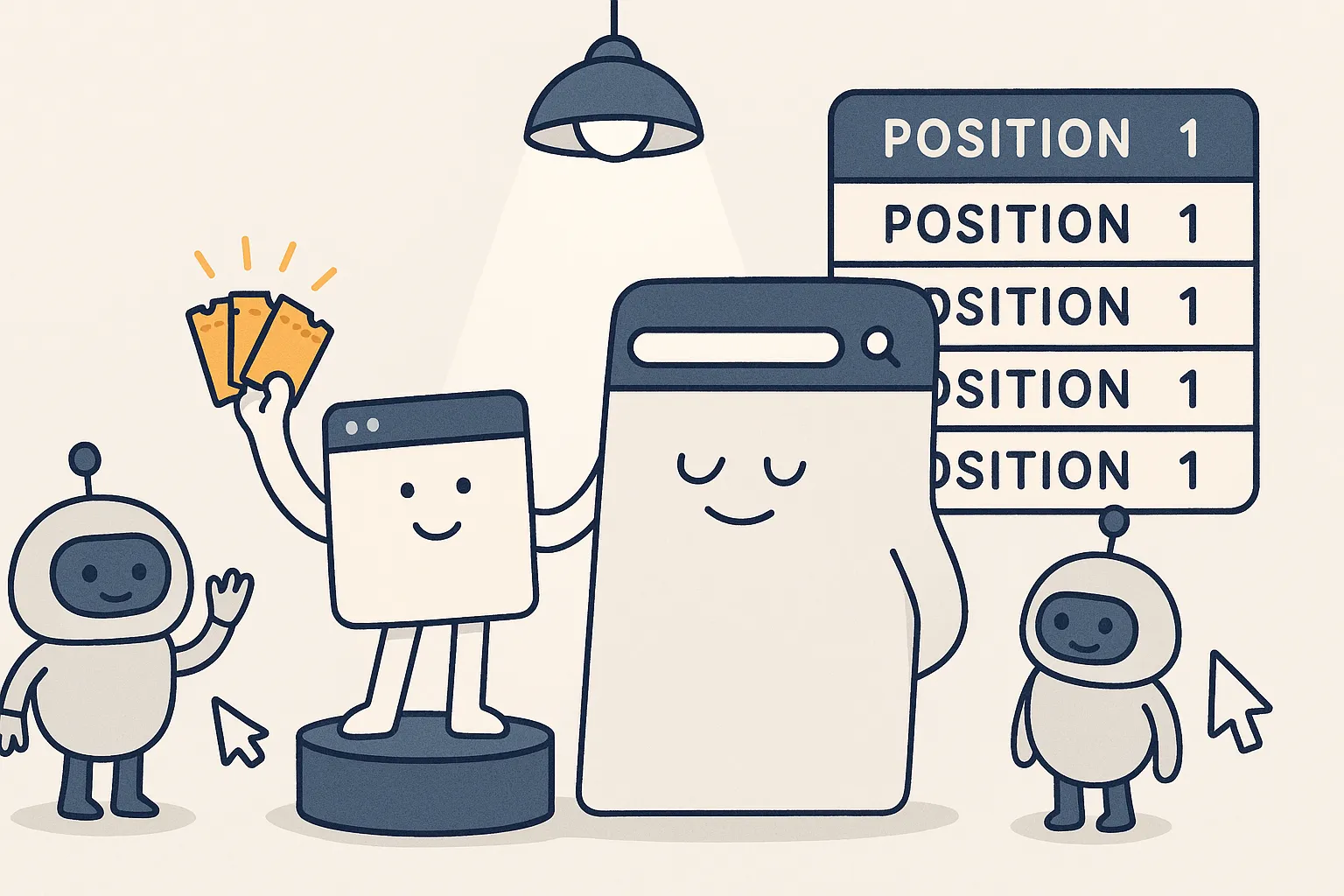
Here is the part that should bother you more than it does. The rank trackers everyone runs, Semrush, Ahrefs, even Google Search Console, will log an AI Overview citation as position #1. Sit with how inflationary that is. Before AI Overviews, there was exactly one number one on a results page. One. Now an AI Overview can cite ten brands in a single answer, and the tools will happily report all ten as ranking #1. Ten “number ones” on one query. That is bullshit, and it is the current state of the art.
It stings because these are the best tools we have, the ones the whole industry runs on, and nobody has enough hours in the day to hand-audit every “position 1” the dashboard hands them. To be fair, sometimes a #1 AI Overview citation is a genuinely good one, your brand actually named and recommended in the answer. The problem is the tool cannot tell you which kind you have. A real named recommendation and a throwaway footnote citation both come back as “position 1,” so the number is worthless exactly when you need it to be honest, and the inflated version goes straight into a report where a brand decides it is dominating a page it is barely visible on.
It blows that this is where the industry sits. The only fix is better tracking becoming standard, measuring named versus cited instead of collapsing both into a rank, and it will come, probably faster than the tools would like. Google is already moving to sell ads inside the AI Overview, and a paid surface eventually forces real measurement. Until then, treat any “position 1” that is really an AI Overview citation as the unreliable number it is.
Why citation counts are so seductive
Citation counts are popular for the same reason every vanity metric is popular: they are easy to count, they only go up, and they look like progress on a slide. A rising citation number is a comfortable thing to show a CMO. It is also disconnected from whether anyone is choosing you.
The discipline is to refuse the comfortable number. When someone shows you a citation count, ask the only question that matters: for the prompts our buyers run, are we the name in the answer, and is that turning into pipeline. If the answer is no, the citations are decoration. Earn the named spot the real way, by ranking in classic search, publishing first-party data and a defensible point of view, and being mentioned across the web, then score yourself on whether the model says your name. Not on how many footnotes you collected.
FAQ
How do I get mentioned in an AI Overview?
Getting mentioned, or named, in an AI Overview comes down to the same work that earns any recommendation: rank in classic search so you are in the retrieval set, cover the long-tail and pain-point queries the fan-out reaches, and get mentioned across the web through digital PR and organic social so the model has evidence you are the answer. The full tactical playbook is its own piece, how to rank in AI Overviews (get named, not cited). This piece is about how to measure whether it worked: track named versus cited, not citation counts.
Is being cited in an AI Overview good?
It is fine, but it is not the goal, and on its own it can be misleading. Being cited means you were a source. It does not mean the answer named you as the recommendation, and studies show AI answers frequently cite a brand’s own page while recommending a competitor. Treat a citation as table stakes and measure whether you are actually named.
What are brand mentions in off-page SEO?
In classic off-page SEO, brand mentions are references to your brand across the web, linked or unlinked, that signal authority and reputation. In AI search the concept sharpens: the mentions that matter most are the ones inside AI answers, because LLMs synthesize from across the web and surface the brands they see referenced and trusted in context. Mention share across the web feeds whether you get named in the answer.
How do you measure AI or LLM visibility?
Track brand-mention share, not citation count. Define the decision-stage prompts your buyers ask, then for each one record whether your brand is named in the answer, which competitors are named instead, and where the answer is sourcing from, across both AI Overviews and the major LLMs. Tools like Scrunch and Profound are built for this. Tie the results to influenced pipeline so a rising mention number means real demand, not a prettier dashboard.
Can you be cited a lot and still have low AI visibility?
Yes, and it is more common than teams expect. On one account I run, the brand is the most-cited domain in its entire category yet still is not the brand most answers name. On another, the brand surfaced in only 3% of tracked LLM responses while two competitors sat at 26% and 21%. High citation counts and low named-visibility coexist easily, which is the whole reason to measure mentions instead of citations.