How to Rank in AI Overviews: Get Named, Not Cited
How to rank in AI Overviews: being named in the answer beats ranking #1, a citation that recommends a competitor is worthless, and what actually earns the spot.
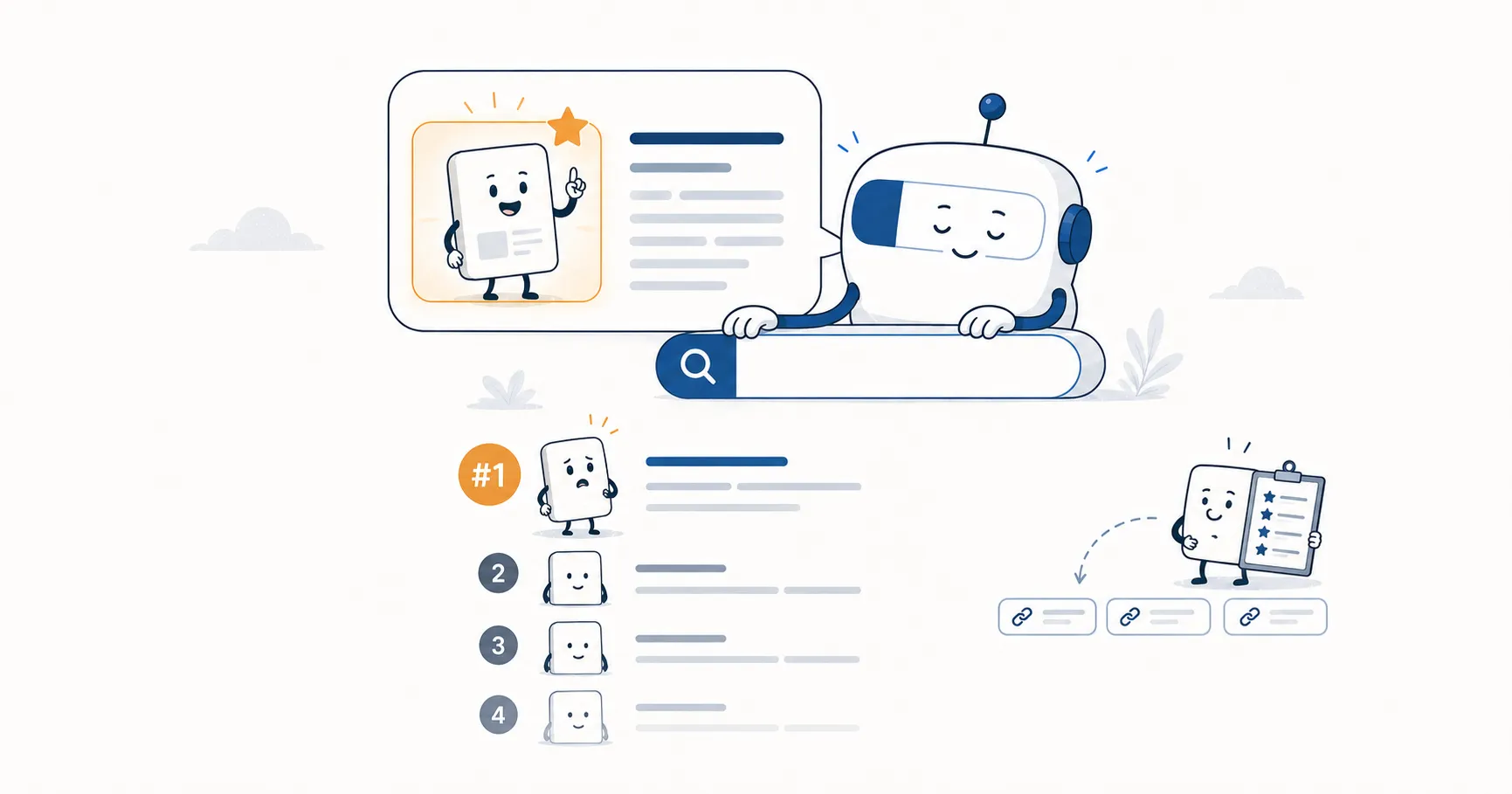
Ranking in the AI Overview beats ranking #1
Most guides on how to rank in AI Overviews, or how to appear in AI Overviews, treat the AI Overview like an eleventh blue link: climb high enough and you get pulled in. Backwards. SEO for AI Overviews is a different job, the core of generative engine optimization,, and the goal is not a slot, it is being the named recommendation. Here is the claim I will actually defend: I would rather be named in the AI Overview than rank #1 in the organic results.
The reason is position, literally. The AI Overview renders at the very top of the page, above the #1 organic result. So “ranking #1” now means ranking below the answer. If your brand is named inside the AI Overview, you are the first thing the searcher reads, before they ever reach the link everyone spent a decade fighting for. Being in the answer is the new above-the-fold. Ranking #1 is the new page two. And in B2B the stakes are higher than the SERP layout suggests: roughly 47% of buyers now start their research inside an AI tool before they visit a single website (Forrester), building their shortlist from answers, not links.
This is the practical edge of the Great Decoupling: impressions and rankings hold or rise while clicks fall, because the answer is consumed on the page. The whole shift, watched across five B2B SaaS verticals, points the same direction. If you are still optimizing to move from #3 to #1, you are optimizing the slot underneath the thing people actually read.
Get named, not cited (a citation is not a recommendation)
Here is the distinction the entire category gets wrong, and it is the one that matters most.
Being cited in an AI Overview is not the same as your brand being named in the answer. The AIO writes a paragraph, then hangs a row of source links beneath it. The citation is the source link. The name is whether the synthesized text actually recommends you. They are not the same thing, and treating them as the same is how teams fool themselves with a rising dashboard while their pipeline goes nowhere.
There is now hard data on exactly how wide that gap is. Lily Ray ran 100 B2B “best [category] software” queries through Ahrefs Brand Radar across April, May, and June 2026. Of the 80 that triggered an AI Overview, brands’ own self-promotional “best” listicles were cited 323 times. But in 224 of those cases, Google cited the brand’s own page and then recommended a competitor. Net result: when Google cites your own “best” listicle, it recommends a competitor 69% of the time. Her line is the whole thesis in five words: a citation is not a recommendation. Earlier reporting in the same vein found SaaS and B2B brands lost 30% to 50% of their visibility after leaning on self-ranked “best” pages.
So my position is blunt: I do not care whether my client’s site is the citation. I care whether the answer names my client as the best. If a Reddit thread, a third-party roundup, or even a competitor’s comparison page is the source Google pulls from, and the answer that comes out says my client is the one to buy, that is the win. A citation where my brand never appears in the sentence the searcher reads is worthless. The most-cited domains for “best” queries are now Forbes, Reddit, and YouTube anyway, so chasing the citation on your own listicle is chasing the wrong prize twice over.
I have watched the named version pay off. On an HR-tech account I run, the content was pulled into a Google AI Overview with the brand named in the answer itself, not buried in a source row. On a legal SaaS account I run, AI Overview appearances rose from 60 to 105 over six months, and the program that drove it was the same one that made organic the largest demo channel in the business, which you can read in the legal SaaS organic-growth case study. Named in the answer is the asset. The footnote is decoration.
The number-one way to rank in AI Overviews: rank in classic search
This sounds obvious and is still the most important thing on the page: of all the AI Overviews ranking factors, the biggest single input to AI Overview visibility is what you already rank for in classic organic search. It sounds like “duh, rank well to rank well,” but it is more specific than that, because of how the AIO is built.
Google does not look up your exact query. It uses query fan-out: it decomposes one search into 8 to 12 related sub-queries, fires them in parallel, retrieves the best content for each, and synthesizes one answer. Search “best project management tool for a remote legal team” and the system quietly runs “top project management software 2026,” “remote team collaboration features,” “project management pricing comparison,” “legal workflow software,” and more, then merges what it finds. The brand named in the answer is the one that shows up, credibly, across that whole cluster of sub-queries.
You're not optimizing one page for one keyword. You're trying to be the source the model keeps hitting across the whole cluster.
That changes the job. You are not optimizing one page for one keyword. You are trying to be the well-ranked, authoritative source the model keeps hitting as it fans out across the sub-questions around a topic. Classic SEO (crawlable, structured, schema’d, genuinely authoritative content) is the price of entry, because if you do not rank for the fan-out, you are not in the retrieval set the answer is built from. The reason thin pages never make it is the same reason they land in crawled, currently not indexed: Information Gain. And schema is how you stay legible to the system doing the fanning out. None of it is a trick. It is being the source worth retrieving for an entire cluster, not one phrase.
Win the long tail, not the head term
The fan-out has a second consequence that breaks the old keyword playbook: the head term matters less than it ever has, and the long tail matters more.
AI Mode queries run about three times longer than traditional search queries, follow-up queries are growing more than 40% month over month, and the longer and more specific a query gets, the more likely it is to trigger an AI Overview at all (queries of eight words or more trigger one far more often than a head term does). As Google pushes users toward AI Mode, search is getting more conversational, more specific, and more intent-loaded by the month.
So stop chasing the high-volume head keyword as the goal. Volume is no longer the thing. Pain-point intent and the cluster of surrounding, niche questions are the thing. “Project management software” is a vanity target; “how do small law firms track billable hours across cases” is where the buyer actually is, where the fan-out actually reaches, and where being the named answer is winnable. Long-tail, specific, problem-shaped content will always do more for AI Overview visibility than one more attempt to rank for a fat head term everyone else is also fighting over.
You cannot do this from your own site alone
Put the last three sections together and the conclusion is unavoidable: you cannot earn your way into AI answers by publishing on your own domain and waiting.
The AIO synthesizes from across the entire web. Your owned content gets you eligible and gives the model something accurate to retrieve. But getting named happens when you show up, consistently and credibly, everywhere the model looks: third-party category lists, Reddit threads, YouTube, review sites, the press. That is an owned plus earned plus social problem, and it is the half of generative engine optimization almost nobody operationalizes. If you are not running digital PR and an organic social strategy, the model has no corroborating evidence that you are the answer, so it names someone who does.
This is the part that takes real work and cannot be faked. You do not post one listicle, mark up some schema, and hope. You run a full strategy: authoritative owned content for the fan-out, digital PR to get mentioned in the third-party sources Google trusts for “best,” and organic social so your brand is visible across the surfaces the model reads. One post and a prayer is not a strategy. It is how you stay invisible while a competitor with a worse product and a better mention footprint gets named instead.
How to know if it is working
You cannot improve what you cannot see, and rank tracking will not show you this. Stop watching position and start watching whether your brand is named in answers, for the prompts that actually matter to your buyer, across both AI Overviews and the LLMs. Tools built for it (Scrunch, Profound, and the category around them) track exactly that. The catch worth saying out loud: you are only as good as the prompts you track. Pick the questions a real buyer asks at the decision stage, watch whether you are the named answer or the absent one, and tie that to pipeline rather than to a citation count. The gaps are brutal once you actually measure them: on a cybersecurity SaaS account I run, the brand surfaced in just 3% of tracked LLM responses while two larger competitors sat at 26% and 21%, a share-of-voice gap rank tracking never shows because on Google the gap was a fraction of that size. The full how-to on tracking is its own piece, because doing it well is more than installing a tool.
FAQ
What is the difference between AI Overview visibility and citations?
Visibility, done right, means your brand is named inside the answer a searcher reads. A citation is just your URL in the source list beneath the answer. They come apart constantly: Google can cite your page while recommending a competitor in the text, which it does 69% of the time when it pulls a brand’s own “best” listicle. Track being named, not being cited, because the citation is invisible to the human and the name is what drives the decision.
Is ranking in an AI Overview really better than ranking #1?
For most queries, yes. The AI Overview renders above the first organic result, so being named in it means you appear before the #1 link, where roughly two-thirds of searches now end without a click anyway. A #1 ranking sits below the answer. I would rather be the brand named in the AI Overview than the one ranked first in the links underneath it.
What is the difference between being cited and being named in an AI Overview?
A citation is a source link; being named is your brand appearing in the synthesized recommendation itself. The gap is enormous: in a 100-query B2B study, brands’ own listicles were cited 323 times but the brand was left out of the recommendation in 224 of them. If the answer does not say your name, a citation does almost nothing for you. Optimize to be the recommendation, not the footnote.
Do my Google rankings still matter for AI Overviews?
They matter most. AI Overviews are built with query fan-out: Google breaks one search into 8 to 12 sub-queries and pulls from what already ranks for each. If you do not rank across that cluster of sub-questions, you are not in the set of sources the answer is assembled from. Classic SEO is the entry fee for being eligible to get named.
How do long-tail and longer queries affect AI Overviews?
They are increasingly where the game is. AI Mode queries are about three times longer than traditional searches and getting longer, and longer, more specific queries trigger AI Overviews far more often. Because the fan-out reaches into niche, pain-point sub-questions, specific long-tail content earns answer visibility that head-term keyword pages never will. Optimize for the buyer’s actual question, not the high-volume phrase.
How do I track whether my brand is showing up in AI answers?
To track AI Overviews and the major LLM answers, use a tool built for AI visibility (Scrunch, Profound, and the category around them) rather than a rank tracker. Define the prompts a real buyer would ask at the decision stage, then track, for each one, whether your brand is named in the answer, which competitors are named instead, and where the answer is sourcing from across AI Overviews and the major LLMs. You are only as good as the prompts you track, so choose them deliberately and tie the results to influenced pipeline, not to a citation count.
How do you rank for, or get featured in, AI Overviews?
How to get featured in AI Overviews and how to optimize for AI Overviews come down to the same playbook, and there is no separate “AI search” algorithm to hack. Rank in classic search first, because Google builds the answer with query fan-out and pulls from what already ranks across the sub-questions. Win the long tail and pain-point queries where the fan-out actually reaches, not just the head term. Then get mentioned across the web through digital PR, organic social, and third-party lists, so the model has corroborating evidence you are the answer. That is how you appear in Google’s AI Overview, and how you get ranked in AI answers generally: earn the sources the model retrieves from, and make sure your brand is named, not just cited.
What are Google AI Overviews?
Google AI Overviews are the AI-generated answers that appear at the top of many search results, above the classic blue links. Google assembles them by fanning a query into sub-questions and synthesizing an answer from pages that already rank across those sub-questions, citing some sources and naming brands inside the text. For searchers they resolve the question on the page, which is why so many informational queries now end without a click; for brands they are a new place to be named, which is what the rest of this guide is about.
What changed
- June 30, 2026: Added a FAQ on how to rank for AI Overviews and expanded the answer on tracking AI Overview visibility.