Off-Page SEO in 2026: Your Site Showing Up Isn't Enough
Off-page SEO used to mean backlinks. Now it decides whether AI names your brand at all. Only ~2.6% of what AI cites about you is your own site. The playbook.
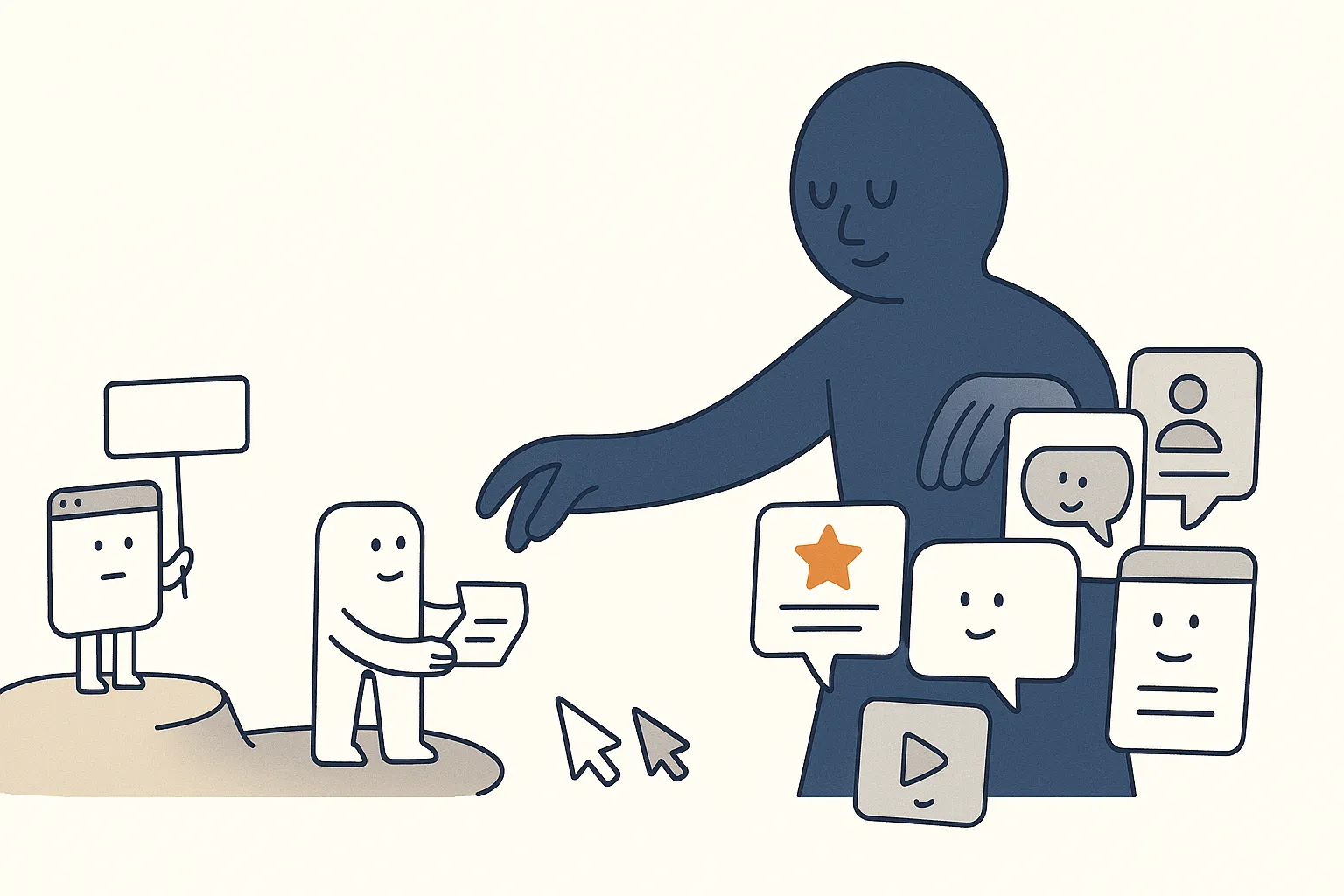
Off-page SEO is every signal that builds authority from outside your site
So what is off-page SEO? Off-page SEO is everything that builds your site’s authority and reputation from outside the site itself. Backlinks are the classic example, but the category is much larger: brand mentions with no link, reviews on third-party directories, threads on Reddit and Quora, YouTube coverage, podcast and press pickups, and your presence on social platforms. On-page SEO is what you do to your own pages. Off-page SEO is what the rest of the web says about you.
For twenty years the shorthand was “off-page SEO equals link building.” That was always too narrow, and in 2026 it is actively misleading. The job now is to be visible, credible, and mentioned across the web, because that is the raw material both Google and every AI model use to decide who to name.
The off-site half of AI visibility is a core track in my generative engine optimization consulting.
On-page vs off-page SEO: eligibility versus visibility
People often search on page and off page SEO together, so here is the cleanest way to hold the difference between these SEO fundamentals: on-page SEO makes you eligible, off-page SEO gets you surfaced. On-page work, your content, structure, schema, internal links, is table stakes. It qualifies you to compete. It does not, on its own, make a model choose you over a competitor when it assembles an answer.
| On-page SEO | Off-page SEO | |
|---|---|---|
| Where it lives | Your own pages | The rest of the web |
| What it does | Makes you eligible | Gets you surfaced and named |
| How much you control it | Fully | Influence only |
| AI-era role | Into the index | Into the answer |
Off-page is the tiebreaker, and increasingly the whole game. When someone asks ChatGPT “what is the best project management tool for a small agency” or types a comparison query that fires an AI Overview, the answer is stitched together from sources across the web. Your own domain is one small input. What everyone else says about you is most of it. You can have a flawless on-page setup and still be invisible in the answer because nobody off your site corroborates that you belong there.
That is the shift: on-page gets you into the index, off-page gets you into the answer.
Is off-page SEO still relevant? It matters more in the AI era
Yes, and it is more important now than it has been in a decade. The reason is structural. LLMs and AI Overviews build answers by synthesizing what the web says about a topic, so a brand that is mentioned everywhere gets named and a brand that is mentioned nowhere gets skipped, no matter how good its own pages are.
I can put a hard number on how off-site this really is. Across six B2B SaaS accounts I pulled a first-party citation export, every domain an AI answer cited across a large set of tracked prompts, and aggregated it. Of all the sources cited about a brand’s own category, third-party sites were about 88.7%, competitors about 8.7%, and the brand’s own domain about 2.6%. On average, a company’s own website was only the 3.7th most-cited source about its own category. In the cybersecurity account it ranked 9th, out-cited by four different competitor domains.
Sit with that split. The thing you control most, your own site, is roughly one fortieth of what AI reads to decide who you are. The other ~97% is off-page, and most of it is out of your direct control but not out of your influence. The full per-vertical breakdown and the fragmentation behind it live in the generative engine optimization statistics data drop. The takeaway for this post: if off-page is 97% of the input, treating it as an afterthought is malpractice.
This is also why a citation is not the finish line. Being one of the sources an AI reads is worth little if your brand is not the name it says back. That gap, cited but not named, is its own problem, covered in most cited is not most named.
Where LLMs actually read you: Reddit, YouTube, review sites, and social
The same citation data shows exactly which off-site sources feed AI answers, and it is the same short list in every industry. Present in essentially every account: YouTube, Reddit, and LinkedIn for community and social; G2, Capterra, GetApp, TrustRadius, and Gartner for software reviews and analyst coverage; Quora and Wikipedia for reference; and trade press like Forbes and TechRadar. Software-review directories and community threads punch far above owned domains.
That maps to a POV I have repeated to every account for a year: if you are not running an organic strategy across LinkedIn, Reddit, and YouTube, you are cooked, because AI needs to see you mentioned all across the web before it will name you. This is not a vanity social-media argument. It is a retrieval argument. The model can only name sources it can find, and those are the surfaces it finds them on.
The cost of ignoring it is measurable. On the cybersecurity account, the limiting factor on AI visibility was not the site, it was third-party mention volume: competitors were discussed constantly across the web and this brand much less, and that awareness gap translated directly into how AI tools answered “what is the best tool for a company this size.” As I put it in that account’s notes: limited third-party visibility is capping the AI citations. The on-page was fine. The off-page was the ceiling.
Off-page SEO techniques that move AI visibility
Here is the modern off-page playbook, ordered by what actually moves AI and search visibility for B2B SaaS. Think of it as owned plus earned plus social, all one job.
- Digital PR and earned mentions. Get named in the third-party roundups, comparison articles, and industry publications that both Google and AI models trust for “best” and “top” queries. A brand mention with no link still counts, because AI reads the text around the link as well as the href. Expect informational blog clicks to keep falling and never come back once a new search experience fully rolls out, so how often you are mentioned across the web, and in what context, matters more every quarter.
- Own your review-directory presence. G2, Capterra, GetApp, TrustRadius, and Gartner show up as AI sources in every vertical I track. Claim the profiles, drive real reviews, keep the category and feature data accurate. This is off-page SEO that directly feeds the “best tools” answer.
- Show up on Reddit and Quora, honestly. These are top-cited community sources. You cannot spam your way in, but you can be genuinely present in the subreddits and threads where your buyers ask questions. Paid posts do not pass authority; real participation does.
- Run an organic LinkedIn and YouTube strategy. LinkedIn articles and YouTube videos are consistently cited sources. Repurpose your best bottom-of-funnel content onto them so the same expertise exists on the surfaces AI reads.
- Build the entity signals. Consistent brand information across Wikipedia-style references, your Google Business and knowledge-panel data, and authoritative profiles helps models understand who you are and connect the mentions back to your brand.
The measurement changes to match. Stop counting backlinks alone and start tracking third-party mention and citation share: how often you are named across the web versus your competitors, and whether that shows up in the AI answers your buyers actually see. Backlinks are one input to authority. Being the named answer is the outcome.
The off-page SEO checklist
The playbook above, condensed into a checklist you can run against your own brand:
- Claim and optimize your review-directory profiles. G2, Capterra, GetApp, TrustRadius, and Gartner. Drive real reviews and keep category and feature data accurate.
- Earn third-party mentions with digital PR. Get named in the “best” and comparison roundups that rank for your category, link or no link.
- Show up on Reddit and Quora honestly. Be genuinely present in the threads where your buyers ask, without spamming.
- Run an organic LinkedIn and YouTube presence. Repurpose your bottom-of-funnel content onto the surfaces AI reads.
- Keep entity signals consistent. Align brand data across reference sources and your knowledge-panel and Google Business profiles.
- Measure mention and citation share. Track how often you are named across the web versus competitors.
Pair it with strong internal linking and real E-E-A-T signals on-site, so the authority you earn off-page has somewhere to land.
Off-page SEO FAQ
What is the basic difference between on-page and off-page SEO?
The basic difference is location and control. On-page SEO is everything you do on your own pages, content, structure, headings, internal links, and schema, all of which you fully control. Off-page SEO is every authority signal that lives on domains you do not own, backlinks, brand mentions, reviews, and community threads, which you can influence but not dictate. On-page makes a page eligible to rank; off-page is what convinces Google and AI models that other credible sources vouch for it. You need both: a technically perfect page nobody references stays invisible, and strong off-page signals pointing at a weak page waste the authority.
What are some off page SEO examples?
Off page SEO examples include a review of your product on G2 or Capterra, a Reddit thread where users recommend you, a “best tools” roundup on an industry publication that names you, a LinkedIn article or YouTube video covering your category, a podcast mention, or a backlink from a trade site. Each one is a vote, readable by both Google and AI models, that your brand belongs in the conversation. On-site SEO is what you do to your own pages; off-site SEO is everything the rest of the web says about you.
What are off-page SEO tools?
Two categories now. For classic link and mention analysis, backlink tools like Ahrefs and Semrush show who links to and mentions you and your competitors. For the AI-era layer, AI-visibility trackers like Scrunch and Profound show whether your brand is named and cited in AI answers, and which off-site sources those answers pull from. The first tells you your link footprint; the second tells you whether that footprint is translating into being the named answer. For the mechanics of earning links and mentions specifically, see backlinks and digital PR.
What are the main types of off-page SEO?
The main off page SEO types are backlinks (earned links from other sites), brand mentions and citations (named references, linked or not, especially on the review sites and communities LLMs read), digital PR and guest content, and social and community presence like Reddit, YouTube, and LinkedIn. In the AI era they collapse into one goal: being talked about, accurately, on the third-party sources that both Google and AI models trust. Links are one type of off-page signal among several.
What changed
- September 29, 2026: Tightened the writing throughout and linked the related service page.