The AI SEO Tools I Actually Use, Task by Task
Not a best-of roundup. The real AI SEO tools I run across five B2B SaaS accounts, the job each one does, and the gripe that comes with it.
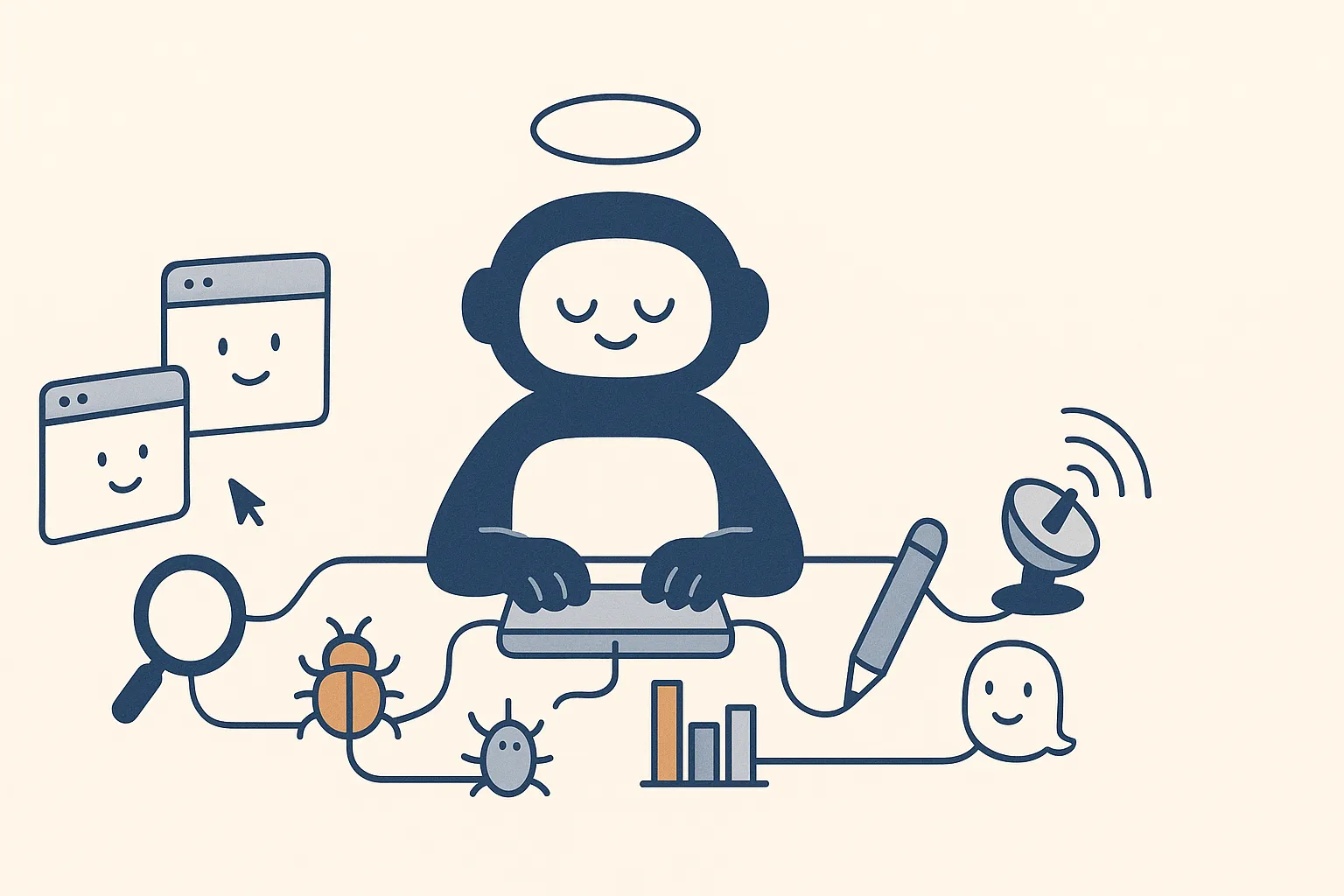
My actual AI SEO tool stack, and why it circles back to Claude
Every “best AI SEO tools” post is the same: fifteen products, an affiliate link on each, and zero evidence the author has run a single one on a live account. This is the opposite. These are the tools I actually use to run SEO and content across five B2B SaaS verticals, sorted by the job they do, each with the honest verdict and the thing that drives me up the wall about it.
The pattern that matters more than any single tool: the whole stack circles back to Claude right now. Not because it writes the posts, but because it has become the connective layer the other tools plug into. Ahrefs feeds it ranking data through an MCP connection, Screaming Frog feeds it crawl data the same way, and the judgment work that used to mean a day in a spreadsheet now happens in a conversation with the data already loaded. The moat is not any one tool in this list. It is the workflow that wires them together. Keep that in mind as you read, because the verdicts below are really about where each tool fits around that center.
| Job | Tool | The gripe |
|---|---|---|
| Keyword & SERP research | Ahrefs + Claude (MCP) | Rankings lag; logs an AIO citation as “position 1” |
| Long-form drafting & editing | Claude | |
| Meta titles & short-form | ChatGPT | Claude is genuinely bad at meta tags |
| Competitive deep dives | ChatGPT Deep Research | Skip Gemini’s, glitchy and unhelpful |
| Content audits at scale | Claude | |
| Technical crawls | Screaming Frog + Claude (MCP) | Overkill unless the site is genuinely large |
| LLM-visibility tracking | Scrunch | You’re only as good as the prompts you track |
| Influenced-pipeline attribution | Dreamdata |
Keyword and SERP research: Ahrefs, plus a manual Google check
Start in Google itself. Before any tool, I run the actual searches by hand, because the live results page is the only fully up-to-date source of truth: what ranks, what AI Overview fires, which features eat the clicks. No tool refreshes fast enough to replace looking.
For the heavy lifting my main tool is Ahrefs (I ran SEMrush for about three years before it). It is excellent, with one structural catch that every rankings tool shares: the keyword positions only refresh on a cycle. Report a ranking to a client straight off a tool and you may be quoting a number that is weeks stale, which is exactly when it makes you look like you have no idea what you are doing. So you verify the ones that matter in Google by hand, every time, which is maddening. It is the tedious, non-optional tax on every rank-tracking product, and anyone who tells you their tool’s positions are live is selling you something.
My sharper gripe with Ahrefs is how it handles AI surfaces. It is muddy to separate true organic position from SERP features, and it logs an AI Overview citation as position 1. That is flat wrong, and it quietly flatters every report built on it, because a citation is not your brand being named, and the link can sit buried deep in the answer. There is a real difference between owning a true number-one result, being the named recommendation in an AI Overview, and merely being one of a dozen citations under it. Collapsing all of that into “position 1” hides the thing that now matters most, which is whether the model actually names you in the answer.
The unlock on this job is the Ahrefs MCP connection into Claude. Pull the data with Ahrefs, then let Claude cluster it, map the fan-out, and flag where pages cannibalize each other, in one pass instead of a day of manual sorting. Ahrefs plus Claude genuinely changed how I do keyword research.
Writing and editing: Claude for depth, ChatGPT for speed
For drafting and editing, Claude is the best, and it is not close for long-form. It is far easier to iterate with, the Projects setup and markdown files make a real document workflow possible, and it is better at following a specific outline or matching the exact shape you want the piece to take. It adds the human element that the others miss. ChatGPT gives you consistent output, but consistent is not the same as good, and you can feel the absence of a point of view.
ChatGPT still wins a real set of jobs, just shorter ones. It is my pick for quick answers, for tightening up a reply to a client, for taking a messy paragraph of my own thinking and giving it structure, and for short-form copy. It is also flatly better than Claude at meta titles and descriptions, where the brief is to be tight and formulaic rather than to have a voice. Use it for those and you will move faster.
Gemini I have given up on. It hallucinates, loses the plot mid-task, and burns more time checking its work than it ever saves. For this kind of work it is the one I actively avoid.
Research and competitive deep dives: ChatGPT Deep Research
For competitive analysis and getting up to speed on a new client or industry fast, ChatGPT Deep Research clears everything else available. Point it at a market or a competitor set and it does the kind of structured, sourced dig that would otherwise eat half a day, and it gets you fluent on an unfamiliar account quickly. This is the one job where I reach for ChatGPT first and do not look back.
Auditing content at scale: Claude
When a site has hundreds or thousands of pages, the audit is not a judgment problem, it is a volume problem, and that is squarely Claude’s job. I built a scoring tool with Claude that grades every page on a consistent rubric and buckets it Keep, Improve, Consolidate, or Kill, so a 900-page audit collapses into an afternoon. The same Ahrefs-MCP data that powers keyword research feeds this, which is why the stack feels less like separate tools and more like one workflow.
Tracking what actually matters: Scrunch and Dreamdata
This is the layer most tool roundups skip, and it is the one that proves your work. Scrunch is what I use to track LLM visibility: whether your brand is named in AI answers for the prompts that matter, not just whether you rank. The discipline there is prompt selection, because you are only ever as good as the prompts you track. (I want more hands-on time with Profound before I call a winner between the two.)
For the money question, Dreamdata stitches organic into the CRM so you can report influenced pipeline instead of sessions, which is the number that survives a zero-click world. Under all of it sit GA4 and Google Search Console, free and non-negotiable: GSC in particular is the cleanest read on impressions, queries, and the big technical errors.
Rank tracking, backlinks, and technical crawls
Ahrefs vs SEMrush: I run Ahrefs daily now, after years on SEMrush. SEMrush is the more intuitive interface, but Ahrefs has more data and is the better tool for backlinks. Both will get the job done; pick on price and which one you think faster in.
Technical crawls: Screaming Frog plus Claude. Screaming Frog is the workhorse, and since it shipped its own official MCP server in SEO Spider v24, connecting that to Claude is state of the art, because you can interrogate a full crawl in plain language instead of pivoting a 50-column export. The honest caveat: unless you run a genuinely large site, you may not need it at all. Search Console will surface the big errors, and if you watch your meta info and broken links from day one rather than letting them pile up, a lightweight setup holds for a long time.
The throughline: every AI SEO tool feeds back into Claude
Read back through the stack and the same name keeps surfacing. Ahrefs plus Claude for research, Screaming Frog plus Claude for crawls, Claude for the audit, Claude for the draft. The individual tools matter, but the edge is in feeding each one’s data into a single model with enough context to do the thinking. Pick your tools for the data they own, then wire them into one place that can reason over all of it. That is the actual state of the art in 2026, and it is the part a wall of 15 logos and affiliate links will never tell you.
Pick your tools for the data they own, then wire them into one place that can reason over all of it.
FAQ
What are the best AI SEO tools?
The ones you will actually run, not the longest list. My working stack is Ahrefs for keyword and backlink data, Claude for research synthesis, drafting, and large-scale content audits, ChatGPT for quick copy, meta tags, and Deep Research, Scrunch for LLM-visibility tracking, Dreamdata for influenced-pipeline attribution, and Screaming Frog plus GA4 and Search Console underneath. The differentiator is not the tools, it is connecting them (Ahrefs and Screaming Frog into Claude over MCP) so one model can reason over all the data.
What is the best AI tool for SEO content?
Claude for anything long-form or iterative, because it follows an outline, holds a voice, and is easy to revise with. ChatGPT for short-form and for meta titles and descriptions, where tight and formulaic beats having a point of view. I steer clear of Gemini for content work; it hallucinates and drifts off task too often to trust without babysitting every line.
Are there free AI SEO tools worth using?
Yes, and you should never skip them: Google Search Console and GA4 are free and are the cleanest first-party read on your impressions, queries, clicks, and major technical issues. Google Search itself is the most up-to-date research tool there is, since no paid tool refreshes rankings or AI Overviews in real time. Start there before paying for anything.
Can AI replace tools like Ahrefs?
Not yet, and that is the wrong frame. You still need a data source like Ahrefs or SEMrush for ranking and backlink data that an LLM does not have. What AI replaces is the manual labor on top of that data: the clustering, the prioritization, the cannibalization hunt, the audit. The strongest setup is both, joined, with Ahrefs feeding Claude through an MCP connection rather than either one alone.
What is the best AI tool for keyword research?
Ahrefs for the underlying data, Claude (via the Ahrefs MCP connection) for the judgment layer that turns it into a plan, and a manual Google check on the keywords that matter because rankings tools always lag. That combination is what made keyword research fast for me. The tool alone gives you a list; the workflow gives you priorities.
Do I really need Screaming Frog?
For a large or complex site, yes, and paired with Claude over MCP it is the best technical-crawl setup available. For a smaller site, probably not. Google Search Console catches the errors that actually hurt you, and if you keep an eye on meta data and broken links from the start, you can go a long way without a dedicated crawler.
Can you use the Ahrefs MCP with ChatGPT or Copilot, not just Claude?
Yes, in principle, because MCP is an open protocol rather than a Claude feature. Any MCP-capable client can connect to the Ahrefs MCP server, and the ranking data lands in the conversation the same way. In practice I run it through Claude, because its MCP support is the most mature and it is the model I trust for the clustering and prioritization that turns the export into a plan. ChatGPT and Microsoft Copilot have both been adding MCP support, so the same “pull the data into the chat and reason over it” workflow is opening up there too, just further behind. Pick the client on how well it handles MCP and how much you trust its judgment, not on the connector, which is the same in every case.
What changed
- July 8, 2026: Added a FAQ on whether you can use the Ahrefs MCP connection with ChatGPT or Copilot, not just Claude.