B2B Marketing Attribution: Stop Flying Blind
B2B marketing attribution done right: how multi-touch attribution shows what actually drives pipeline, why UTMs and form-fills lie, and the tool I run daily.
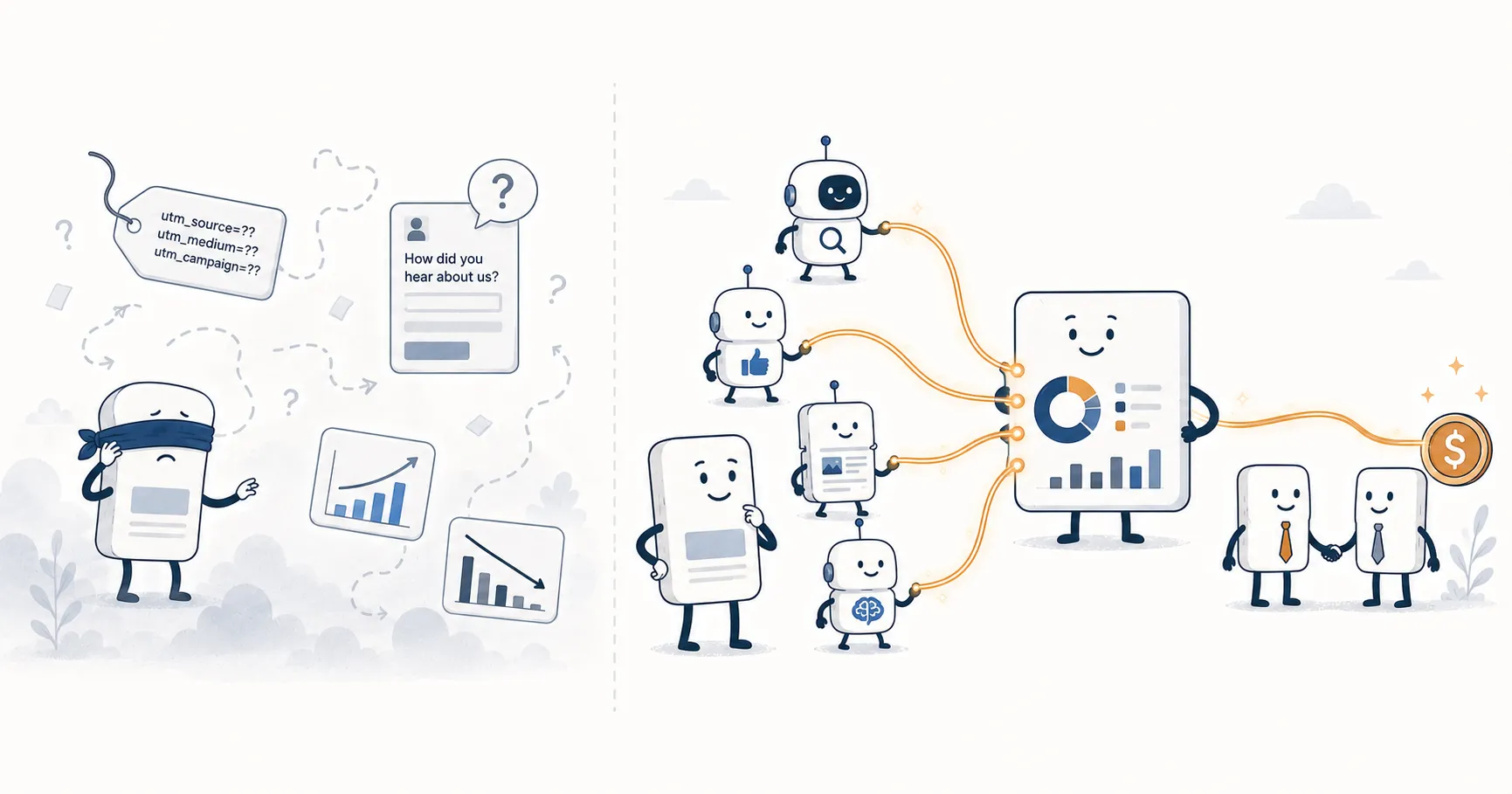
You are flying blind without it
Here is the uncomfortable question I ask most B2B marketing teams: of the deals you closed last quarter, which pieces of content actually touched them on the way in? Most teams cannot answer it. They can tell you traffic was up, or that a campaign “felt” like it worked, or that a form said “Google” in the how-did-you-hear field. None of that is an answer. It is a guess wearing a dashboard.
This is the default state of B2B marketing attribution, and it is broken in exactly the ways generative engine optimization makes worse. You have UTMs that only catch the last click and break the moment someone copies a link or switches devices. You have self-reported attribution fields where buyers type whatever comes to mind, usually wrong. You have GA4 telling you about sessions and a CRM telling you about deals, and absolutely nothing reliably connecting the two. So you stitch it together by hand, guess at the gaps, and present a number you do not actually believe. That is flying blind with a confident voice.
In a long, multi-touch B2B buying cycle, that gap is not a rounding error. It is the whole picture. It is also why a team can look like it is getting traffic but no conversions when the conversions are happening and simply going unattributed.
Attribution that holds up in a budget meeting is part of the reporting I build as an SEO consultant.
What real B2B marketing attribution actually looks like
Attribution worth running has two properties, and most setups have neither.
First, it is multi-touch, not single-touch. First-touch attribution credits whatever the buyer first stumbled on. Last-touch credits whatever they clicked right before converting, usually a branded search or a direct visit, which makes your brand term look like a genius and everything that created the demand look worthless. Real attribution credits every touch along the journey: the comparison page read in March, the webinar in April, the branded search in May that finally booked the demo. In B2B, where a deal involves a buying committee and a six-month cycle, single-touch attribution undercounts and actively misleads.
Second, it is cross-channel and tied to the opportunity. It does not live in the analytics tool looking at pageviews. It lives stitched to the deal in your CRM. This is what CRM attribution actually means: the touches live on the opportunity record, so you can see that organic, paid, email, and a specific blog post all touched the opportunity that became $40K in pipeline. Every channel, every touch, joined to the revenue object. That is the bar. Anything less is a vanity chart.
| Model | Credits | What it does to SEO |
|---|---|---|
| First-touch | The first interaction only | Misses every touch after the first |
| Last-touch | The final click before converting | Flatters branded search and direct; buries the demand creators |
| Multi-touch | Every touch across the journey | The honest B2B model: credits the content that shaped the deal |
B2B attribution models: single-touch, multi-touch, and what actually works
There are really two families of B2B attribution models, and the choice between them decides whether your content ever gets credit. Single-touch models (first-touch and last-touch) hand all the credit to one interaction. Multi-touch models (linear, time-decay, U-shaped, W-shaped, and full-journey influenced) split the credit across every touch that shaped the deal.
For organic content specifically, a multi-touch or influenced model is the only one that tells the truth, and it is where organic’s highest-quality contribution shows up. Organic is almost never a clean first or last touch. A buyer rarely reads one blog post and books a demo on the spot. They hit your comparison page while scoping a pain point, disappear into a buying committee for weeks, talk to peers, come back through a branded search, and convert. Last-touch hands that deal to the branded search and calls organic worthless. First-touch hands it to whatever they happened to land on first. Both miss the middle of the customer journey, which is exactly where organic does its work: shaping how the buyer understands the problem, around the pain points that actually drive the decision.
So the model I run toward for organic is influenced pipeline, which is the whole logic behind the Dreamdata setup below: credit every touch, weight the ones that genuinely moved the deal, and stop pretending a long B2B journey has a single hero interaction. Rarely is an organic touch legitimately the sole reason a deal closed without something else influencing it along the way, so pick a single-touch model and you will systematically defund the content that creates demand. An influenced-touch strategy is the only one that credits that reality.
The number you cannot see any other way
Here is what that buys you, with real numbers. On a legal SaaS account I run, organic drove 362 influenced demos over six months, which was 29% of all demos in the period, the single largest channel, on a fraction of the paid spend. The full program is in the legal SaaS organic-growth case study.
I want to be precise about why that sentence exists: I can only say it because of multi-touch attribution. Last-touch would have handed most of those demos to branded search or direct and made organic look small. Self-reported fields would have caught a fraction. The 29% figure, the thing that protected the entire organic budget in a quarter where sessions softened, is invisible without attribution that stitches every touch to the opportunity. The reframe from sessions to influenced pipeline is the right one, but it is only a slogan until you have the plumbing to actually measure it. This is the plumbing.
It shows which content converts, and how LLM traffic actually performs
The part I did not expect to rely on as much as I do: attribution shows you how individual pieces of content influence pipeline. Not “the blog drove traffic,” but “this specific page touched 14 opportunities worth this much.” That turns content from a faith-based exercise into a portfolio you can actually manage.
And it is the only way I can see the question everyone is asking right now: does AI traffic convert? When a buyer arrives from ChatGPT or another LLM, does that session ever turn into pipeline, or is it tire-kicking? With real attribution I can watch LLM-referred traffic move through to demos and deals. That matters enormously as the Great Decoupling pushes traffic off Google and onto AI surfaces: the channels are shifting fast, and the only honest way to know which of the new ones pay is to attribute them to revenue.
So you know where to spend the next dollar
All of this rolls up to the decision that actually matters: where does the next marketing dollar go?
When you can see what drives pipeline, content strategy stops being a guessing game. You double down on the pages that are quietly producing demos. You refresh the ones slipping. You kill the ones that have driven nothing for a year and free up the budget. Without attribution, you are flying blind in both directions at once: you could be pouring money into a content program that drives zero pipeline and have no idea, or starving a single page that is quietly producing a huge share of your demos and never know it was the one to protect.
The tool I run for this is Dreamdata. It joins every channel and touch to the opportunity in the CRM, attributes pipeline across the journey, and (the underrated part) enriches and backfills the account profile, so I see which company converted, their size, and their fit. That context is what turns attribution from a reporting line into a decision I can defend to a CMO. I am not being paid to say that. I run it across accounts because the alternative, stitching UTMs and form-fills together by hand, does not produce a number I trust.
Why this matters more in a zero-click world
Attribution has always been the right idea and an easy thing to deprioritize. It is not deprioritizable anymore.
Clicks are no longer the unit of value. AI Overviews answer the query on the page, a growing share of buyers research inside LLMs you cannot see (roughly 47% of B2B buyers now start vendor research in an AI tool before any website visit, and McKinsey pegs AI-mediated discovery as influencing $750B in annual B2B buying decisions), and the decoupling between impressions and clicks means raw traffic is a worse proxy for impact every quarter. When the top of the funnel goes dark and the journey runs through surfaces you cannot tag, the only thing that keeps you honest is measuring the demand that actually shows up as pipeline. That is attribution. In a world where you can see less and less of the buyer journey, the discipline of tying what you can see to revenue is the difference between a strategy and a hunch.
If you are doing B2B SaaS marketing without real multi-touch attribution, you are not measuring. You are guessing with extra steps. Fix that first, and every other decision gets easier.
FAQ
What is B2B marketing attribution?
It is the practice of crediting the marketing touches that influence a B2B deal, from first contact through the closed opportunity. Because B2B buying cycles are long and involve a committee, good attribution is multi-touch (it credits every touch across the journey) and tied to the opportunity in your CRM, so you can see which channels and which pieces of content actually drove pipeline.
Why are UTMs and self-reported attribution not enough?
UTMs only capture a single click and break when links are copied, shared, or opened on another device, so they miss most of a multi-touch journey. Self-reported “how did you hear about us” fields rely on buyers remembering and answering accurately, which they rarely do. Both give you fragments. Neither stitches the full journey to the deal, which is why teams relying on them cannot actually say what drove a given opportunity.
What is the difference between single-touch and multi-touch attribution?
Single-touch attribution gives all the credit to one touch, either the first or the last. Last-touch in particular flatters branded search and direct traffic while making the content that created the demand look worthless. Multi-touch attribution credits every touch across the journey, which is the only honest model for B2B, where a deal is influenced by many channels and many sessions over months.
Does traffic from ChatGPT and other LLMs actually convert?
You can only answer that with attribution that follows the session to the opportunity. On accounts where I track it, LLM-referred traffic does show up in pipeline, which is why I treat it as a real channel. As more of the buyer journey moves onto AI surfaces, attributing that traffic to revenue is the only way to know which new channels are worth investing in.
What tool do you use for B2B marketing attribution?
I run Dreamdata. It joins every channel and touch to the opportunity in the CRM, attributes pipeline across the full journey, and enriches the account profile so you know which companies are actually in your pipeline. The specific tool matters less than the capability: multi-touch, cross-channel, stitched to revenue. Without something that does that, you are guessing.
What is an example of marketing attribution?
Say a buyer reads your comparison page in March, attends a webinar in April, runs a branded search in May, and books a demo. Single-touch attribution credits only one of those, usually the last (the branded search). Multi-touch attribution credits all of them, so the comparison page that created the demand gets its share. That full-journey credit is the example worth building toward, because it is the only version that tells you what actually drove the deal.
What is B2B revenue attribution?
B2B revenue attribution ties marketing touches to actual pipeline and closed revenue in your CRM. It is the same discipline as multi-touch marketing attribution, framed around the number finance cares about: which channels and which pieces of content influenced the opportunities that became revenue. For organic, that means reporting influenced pipeline, the dollar value of the deals organic touched on the way in.
What is closed-deal attribution?
Closed-deal attribution credits the marketing touches on opportunities that actually closed-won. It is the strictest cut of attribution: it says “this channel touched the deals that became revenue.” The catch is that it only works if you already have multi-touch attribution stitched to the CRM, because a closed deal in B2B was influenced by many touches over months, and single-touch models will hand the whole win to the last branded search. Report closed-deal credit and influenced pipeline together: closed-won tells you what already paid off, influenced pipeline tells you what is working before the deal lands.
How do you make B2B SaaS marketing attribution board-defensible?
Board-defensible attribution is a number you can put in front of an exec team and defend line by line. Three things get you there. It has to be multi-touch, so you are not crediting a whole deal to one branded search. It has to be stitched to the opportunity in the CRM, so every touch maps to real pipeline. And it has to be enriched with firmographics, so you can name the accounts behind the number and speak to their size and fit. That is the difference between “organic drove traffic” and “organic influenced 362 demos, 29% of the total, on these named accounts.” The second one survives a room full of skeptical executives; the first one does not.
What changed
- September 29, 2026: Tightened the writing throughout and linked the related service page.
- July 13, 2026: Added FAQs on closed-deal attribution and how to make B2B SaaS marketing attribution board-defensible.
- June 30, 2026: Added a section on B2B attribution models (single-touch vs multi-touch), a B2B revenue attribution FAQ, and coverage of CRM attribution.