AI Overview Impressions in Search Console (No Clicks)
Google Search Console now reports AI Overview impressions, but no clicks yet. What the data shows, which formats win citations, and why ads are next.
AI Overview impressions are finally in Search Console
Google Search Console now reports how often your pages appear inside AI Overviews. On June 3, 2026, Google launched a Generative AI performance report that breaks out impressions from AI Overviews and AI Mode, separate from the classic web report. For the first time you can see, page by page, how often your site is being pulled into the answer box that now sits above the ten blue links.
That is the good news, and it is real. For a year the standard complaint about AI Overviews was that they were a black box: you suspected they were eating your clicks, but you had no instrument pointed at them. Now there is one. If your property has access, the data is already waiting, and for my clients it backfills to around May 18, 2026, so you are not starting from zero. You have six-plus weeks of history to read.
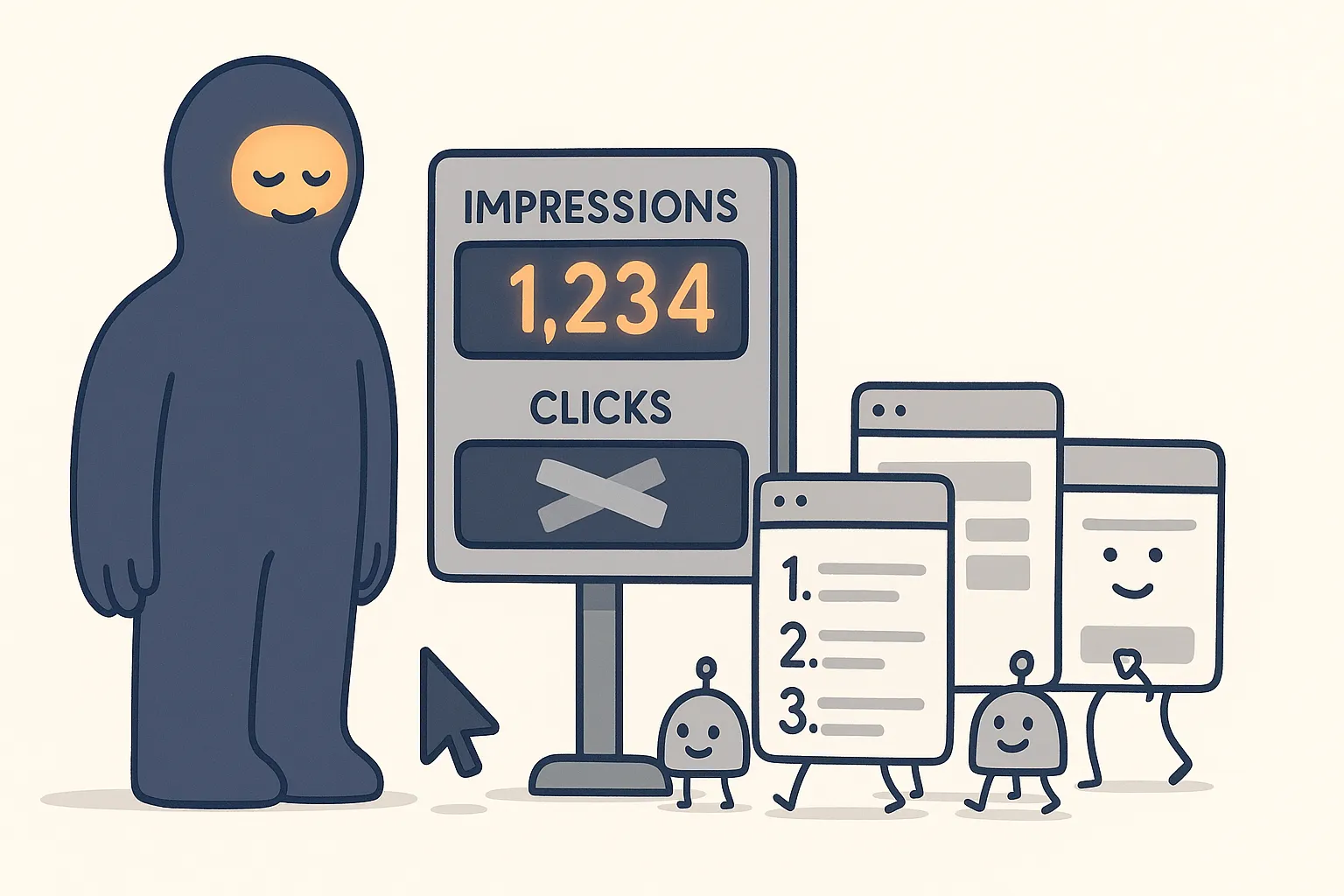
The bad news is in the parentheses of the headline. You get impressions. You do not get clicks.
How to see AI Overview impressions in Search Console
You reach the AI Overview impression data through the standard Performance report in Search Console, not a separate menu item, which is exactly why it is easy to miss. Here is the click path, step by step.
- Open Google Search Console and select the property you want to check.
- Click “Search results” under Performance in the left-hand menu.
- You will land on the performance view you already know: total clicks, total impressions, average click-through rate, and average position across regular Search.
- Look for the box just below that, which reads something like “Get more details on your site’s performance on generative AI features on Google Search,” with an “Open report” button.
- Press “Open report.” Under Generative AI features you will see the impressions your pages earned inside Google’s AI Overviews and AI Mode, which you can then break down by page, country, device, and date.
If that box is not there, your property is almost certainly not in the rollout yet, because the report is live for a subset of sites rather than everyone. Check back periodically, because Google has said it is expanding access.
What the report shows, and what it pointedly does not
The report shows impressions only, and only for AI Overviews and AI Mode. An impression counts each time a link to your site is shown inside one of those generative features. You can group the data four ways: by page, by country, by device, and by date, down to the day. Two of your results in the same AI answer count as a single impression, because it aggregates by property. Search Labs experiments are excluded, and Discover’s generative features sit in a separate report.
Here is what is missing, and it is the whole ballgame: no clicks, no click-through rate, no average position, and no query data. You can see that a page got surfaced in an AI Overview a thousand times. You cannot see whether anyone clicked through, or what they had searched to trigger it.
An impression you cannot tie to a click or a query is a scoreboard with the score taped over. You know the game is being played. You cannot read who is winning.
I will be plain about it: shipping impressions without clicks is a frustrating half-measure, and I do not think the omission is accidental. Clicks are the number that would let you calculate the true cost of AI Overviews to your traffic, and that is precisely the number a platform monetizing that surface is least eager to hand over for free. Which is the more interesting story here.
What is actually earning AI Overview impressions
Across my accounts, two formats dominate the AI Overview impression report: listicles and comparison content, with definitional pages a close third. The “best X tools,” “X vs Y,” and “what is X” pages are the ones Google reaches for when it assembles an answer. That tracks with how the feature works, because an AI Overview is usually synthesizing a ranked set or drawing a distinction, and that is exactly what a good listicle or comparison page already does on the page.
The actionable read: pull your Generative AI report, sort pages by impressions, and look at what the top of that list has in common. For most of my clients it is a listicle or a comparison, and the move is to build more of that shape and to make the existing ones genuinely better than the competing pages, because getting named in the answer beats merely being cited. But it varies by account, and that is the point of having the report at all. A definitional glossary might be your top performer where a comparison library is someone else’s. Read your own data instead of mine.
This is also the first time the impression-up, click-down pattern has its own dedicated dashboard. The decoupling of impressions from clicks was the defining SEO story of the past two years, and now Google has built you a report that shows one half of it in isolation. Use it for what it is good for, which is seeing where you have presence, and do not mistake presence for traffic.
Why impressions-only is not an accident: the ChatGPT ads playbook
We have watched this exact rollout before, one platform over. When OpenAI launched ads inside ChatGPT on February 9, 2026, advertisers got coarse, aggregated reporting first: impressions and spend, with little ability to tie a dollar to an outcome. Within months that changed. By May, OpenAI had shipped a conversion pixel and a Conversions API, added cost-per-click pricing, and switched on cost-per-action bidding for select advertisers. The measurement went from a blunt impression count to clicks and downstream conversions in roughly a quarter.
That is not a coincidence of two companies making the same UX choice. It is the natural sequence for standing up a new ad surface. You start by proving the surface gets seen, because impressions are the easy, safe number to expose. You add clicks and conversions once the surface is established and you are ready to charge for performance. Impression-only reporting is the warm-up, not the destination.
Google is now running step one. The Generative AI performance report gives publishers an impression count for a surface Google is still deciding how to monetize. If the ChatGPT timeline is the template, clicks are not a missing feature, they are the next release.
Where this is going: ads inside AI Overviews
Here is the thesis I will defend: this report is the groundwork for ads inside AI Overviews, and the impression data is the first public hint of the inventory Google plans to sell.
The logic is hard to argue with. Search is moving to AI Overviews, which means the answer box is becoming the most valuable real estate on the results page, and the ten blue links are sliding below it. Google’s revenue has always come from selling position at the top of that page. So the surface that is absorbing the attention is the surface Google has to monetize, or it cannibalizes its own ad business. The only question is timing.
Nobody pays to be below the fold. As AI Overviews become the fold, the ad units follow the attention, and the impression report is how Google starts counting the inventory.
An advertiser will pay to be inside the AI answer for the same reason they pay for the top sponsored slot today: that is where the eyes are. An impression report is exactly what you build first if you intend to eventually tell those advertisers how big the audience is. None of this means organic citation stops mattering. It means the window where AI Overview presence is purely earned, rather than partly bought, is finite. The brands building citation-worthy content now are the ones who will not have to rent their way back in later, which is the same reason I keep arguing that measuring SEO by influenced pipeline rather than raw clicks is the only sane scoreboard in a zero-click world.
What to do with AI Overview impression data right now
The report is limited, but it is not useless. Here is how to get value from impressions while you wait for clicks.
- Check whether you have access and pull the history. The report is rolling out to a subset of properties, not everyone, and preliminary data can shift. If you have it, the data backfills to mid-May, so export it now and start a baseline rather than waiting for the feature to mature.
- Sort pages by AI Overview impressions and find the pattern. The top of that list tells you which of your formats Google trusts for answers. For most of my accounts that is listicles and comparisons. Identify your own winners before you assume mine are yours.
- Build more of what already wins, and make it the best version. If comparison pages earn your impressions, your roadmap is more comparisons and stronger ones, structured so the answer is extractable and your brand is named in it.
- Watch the trend, not the absolute number. With no clicks and no queries, the daily impression count is most useful as a direction. Rising impressions on a page after a rewrite is a signal the rewrite landed in the model’s answer set, which is the closest thing to a feedback loop you have right now.
- Stand up the instrument before the data gets richer. I run my own Search Console pulls and single-variable tests with Claude so that when clicks and query data eventually arrive, the measurement plumbing is already in place. The teams that have been tracking impressions all along will read the clicks far faster than the teams starting cold.
The honest summary: Search Console finally gave us a window into AI Overviews, then frosted half the glass. Use the half you can see through, and assume the rest clears on Google’s schedule, not yours.
FAQ
Can you see AI Overview impressions in Google Search Console?
Yes. As of June 3, 2026, Search Console includes a Generative AI performance report that shows your impressions in AI Overviews and AI Mode, grouped by page, country, device, and date. It is rolling out to a subset of properties, so not every account has it yet, and for the accounts that do, the data backfills to roughly May 18, 2026.
Does Search Console show AI Overview clicks?
No. The Generative AI performance report shows impressions only. There is no click, click-through rate, average position, or query data for AI Overviews. You can see how often your pages are surfaced in an AI answer, but not whether anyone clicked through or what they searched to trigger it.
How far back does the AI Overview data go?
For my clients the report backfills to around May 18, 2026, even though Google announced it on June 3, 2026. The exact start may vary by property as the feature rolls out, but most accounts with access have several weeks of history available immediately rather than starting from the launch date.
What content gets the most AI Overview impressions?
Across the accounts I manage, listicles and comparison content earn the most AI Overview impressions, with definitional pages close behind. AI Overviews tend to synthesize ranked sets and draw distinctions, which is what those formats already do. It varies by account, so the reliable move is to sort your own report by impressions and read the pattern at the top.
Why doesn’t Google show AI Overview clicks yet?
Google has not given a full reason, but the pattern is familiar. New ad surfaces typically expose impressions first and add clicks and conversions later, the way ChatGPT ads went from aggregate impression reporting in February 2026 to click and conversion tracking within a few months. Impression-only reporting is consistent with a surface Google is preparing to monetize, where the click data arrives once the platform is ready to sell performance.
Are ads coming to AI Overviews?
Google has not confirmed a launch, but the direction is clear. Search is shifting to AI Overviews, that surface is where attention now concentrates, and Google monetizes attention at the top of the page. An impression report is the kind of measurement you build first when you intend to sell inventory later. Expect ad units inside AI Overviews, with clicks reporting likely arriving alongside or just before them.