In-House SEO vs Agency vs Freelancer: How to Choose
In-house SEO vs agency vs freelancer: what each really costs, what each is best at, and how to choose based on your stage, budget, and needs, not the sales pitch.
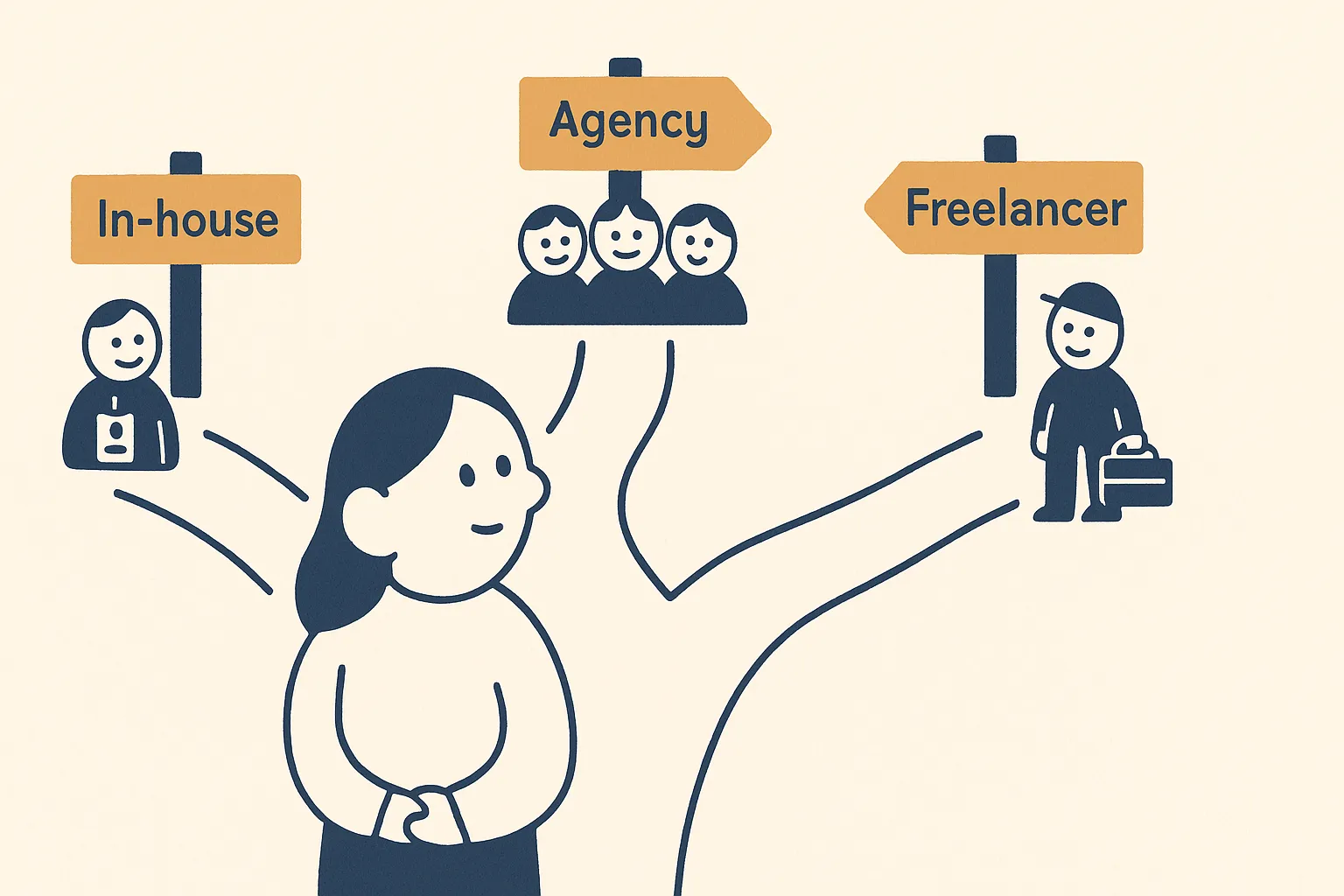
The honest answer to “in-house SEO vs agency vs freelancer” is that none of them is best. They are three different ways to buy SEO services, for three different situations. Once you have picked one, what to hand off and what to keep in-house is the next decision. An agency, a full-time in-house hire, and a freelance consultant solve the same problem in very different ways, at very different costs, and the right choice depends on your stage, your budget, how much SEO work you actually have, and whether you have anyone internal to own it.
So this is not a “here is the winner” post. It is how to match the model to your situation, from someone who has worked on the agency side and now runs a solo practice, so I have seen all three from the inside. The in-house SEO vs agency vs freelancer cost gap is real but it is not the whole story, and the in-house SEO vs agency vs freelancer pros and cons only make sense against your specific stage. Let me lay out what each one really costs and is good at, then how to choose.
The three options at a glance
| Option | Typical cost | Best when | Main trade-off |
|---|---|---|---|
| Agency | $2,500-$10,000+/mo for B2B SaaS | You need a full team’s specialties at once and don’t want to build them | Overhead, and you often get a thin slice of senior attention |
| In-house hire | $70k-$130k+/yr salary, plus ramp-up | You have steady volume and want an owner living inside your product and data | One person can’t master everything SEO touches; hiring risk |
| Freelancer / consultant | $100-$250/hr, or a fixed project fee | Your needs are narrower and you want senior judgment without overhead | Capacity is capped; it’s a single point of failure |
These are not comparable line items, which is the mistake most comparisons make. You are not buying the same thing at three prices. You are buying three different things. For the full pricing picture behind these ranges, see how much SEO costs.
In-house SEO
An in-house hire is a full-time employee who owns SEO inside your company. The cost is a salary, roughly $70,000 to $130,000 and up depending on seniority, plus benefits, tools, and the months it takes them to ramp.
What in-house SEO is good at
An in-house owner lives inside your product, your data, and your team. They sit in the meetings, understand the roadmap, and can move fast because they are not waiting on a client-services queue. For a company where SEO is a core, ongoing channel with steady work, that embedded context is hard to beat.
The in-house trade-off
One person cannot be an expert at technical SEO, content, links, analytics, and now AI-search visibility all at once. You are hiring a generalist and hoping their strengths match your biggest gaps, and if they leave, your entire SEO capability walks out the door. In-house also has a floor of work below which a full-time salary is hard to justify.
When in-house wins
You have enough sustained SEO work to keep someone fully busy, you want deep internal ownership, and you can support one person with occasional outside specialists.
SEO agency
An agency is an outside team you retain, usually on a monthly contract, for a program of strategy, content, technical work, links, and reporting. For B2B SaaS that runs $2,500 to $10,000+ a month, with enterprise programs well beyond that.
What an SEO agency is good at
You get a whole team’s specialties at once without hiring five people: a strategist, content, technical, links, and analytics under one retainer. A good agency brings pattern recognition from working across many accounts, and the capacity to execute at a volume a single hire cannot. When SEO is a serious, multi-workstream channel, that breadth is the draw.
The agency trade-off
You are also paying for overhead, and the senior strategist who sold you often is not the person doing your day-to-day work. The honest version, and I say this having worked on the agency side, is that the biggest risk is committing to a retainer before you can feed it: an agency with no content velocity or no product-market fit behind it bills you monthly for a channel that cannot compound yet.
When an agency wins
You need multiple SEO specialties running at once, you value breadth and execution capacity, and you have the budget and the internal readiness to make a retainer compound.
SEO freelancer or consultant
A freelancer is a single independent expert you hire hourly or per project, $100 to $250 an hour or a fixed fee for a defined piece of work like an audit. An SEO consultant is the more senior, strategy-first version of the same thing.
What a freelancer is good at
You get senior judgment without the agency overhead or the salary commitment. For narrower needs, a specific technical fix, a strategy, a one-time audit, an experienced freelancer often delivers the same quality as an agency’s senior lead, because they are that person, just without the layers. It is also the most flexible: you scale them up or down as the work changes.
The freelancer trade-off
Capacity is capped by one person’s hours, and it is a single point of failure if they get sick or overbooked. Quality also ranges enormously, so vetting matters more here than anywhere else. A freelancer is not built to run five workstreams at high volume the way an agency is.
When a freelancer wins
Your needs are specific rather than a whole program, you want senior expertise without a retainer, or you want a diagnosis and a plan before you commit to anything bigger.
How to actually choose
Match the model to your stage and your need, not to what a peer company did. A few honest rules of thumb:
- If you don’t yet know what’s wrong, none of these first. Start with a one-time audit so you are buying the right help against real problems, not guessing.
- If your need is narrow or one-time (a fix, a strategy, an audit), a freelancer or consultant is almost always the most cost-effective.
- If SEO is a serious multi-workstream channel and you’re not ready to hire, an agency’s breadth makes sense, provided you can feed it.
- If you have steady, ongoing volume and want deep internal ownership, a first in-house hire, often supported by a freelancer or an agency for gaps, is the long-term play.
The most common mistake I see is defaulting to an agency out of habit when a freelancer or a first in-house hire would fit the stage better and cost far less. Buy the outcome, not the org chart.
Most companies don’t over-pay for SEO. They over-buy the wrong model for their stage, then blame SEO when the mismatch doesn’t work.
The hybrid most companies actually land on
In practice it is rarely all-or-nothing. Plenty of teams run an in-house owner for context and speed and a freelancer or agency for the specialist depth one person cannot cover. Others start with a freelancer, prove the channel works, then hire in-house once the volume justifies it, and keep the freelancer on call. The three options are stages and combinations, not a permanent identity. Pick what fits now, and expect it to change as SEO grows.
Whichever you choose, start with a plan
Here is the move that de-risks all three: get a diagnosis before you commit to any of them. A fixed-fee audit tells you what is actually wrong, what the opportunity is worth, and what to fund, so you hire the right model against real priorities instead of a sales pitch. If an agency is right, you brief them better. If in-house is right, you hand your new hire a roadmap on day one. If a freelancer is right, you scope it precisely. That is exactly why my audit is a one-time project with no retainer: it is the step that makes whichever model you choose actually work.
Where should you work as an SEO?
There is a second version of this question that has nothing to do with hiring: not “who should I hire” but “where should I work.” If you are the SEO choosing between the three, the trade-offs mirror the buying ones from the other side of the desk.
Working in-house
In-house is the deep trade. You go deep on one product, own the strategy end to end, and actually watch your work compound over years instead of handing it off at the end of a retainer. You usually get more influence on the roadmap and, often, saner hours. The cost is a narrower range: you touch one site’s problems, not fifty, and it is easier to plateau if the company does not invest in your growth.
There is also a security cost people underrate: it is easier to get fired in-house. If the program is not working, sometimes for reasons genuinely outside your control, you can get canned pretty quickly, and not many companies give one person a lot of leeway when the numbers are flat. You own the outcome, which is great when it compounds and exposed when it does not.
Working at an agency
Agency-side is a fast, broad education. You work across many accounts, industries, and problems at once, so you compress years of pattern recognition into months, and you are surrounded by other specialists to learn from. The cost is volume and pace: more accounts means less depth on any one, client-services pressure is real, and you rarely get to see a long-term strategy all the way through. It is the best place to learn the craft quickly.
The part nobody warns you about is that you do not own the outcome. Sometimes clients suck. You do not get real ownership, and at the end of the day you are beholden to how fast the client can execute, sometimes on the exact things you flag as urgent. You can be the perfect SEO at an agency and still post bad results because a client would not move. That lack of control, not the pace, is the real tax of agency work.
Working freelance
Freelance trades security for autonomy and income control: you pick the work and keep the margin, but you also run a business, with sales, admin, and feast-or-famine included. It is not for everyone, and not everyone wants it, but the bigger truth is you have to genuinely know what you are doing before you can hang a shingle, because there is no team to catch your mistakes. That is why most strong solo SEOs do a tour on the agency side first: a lot of the best in-house and freelance opportunities quietly require agency experience to get in the door. Go independent once you know what you are actually good at.
In-house SEO vs agency FAQ
Is in-house SEO cheaper than an agency?
Not usually, once you count everything. A single in-house specialist runs $70,000 to $130,000+ a year in salary, plus benefits, tools, and ramp-up time, which often lands near or above an agency retainer, for one generalist instead of a team’s worth of specialties. In-house can win on long-term value when you have the volume to use them fully and want embedded ownership, but “cheaper” is the wrong frame. The right question is which model returns more influenced pipeline for the total cost.
In-house SEO vs agency vs freelancer salary: how much does an in-house SEO cost?
The in-house SEO vs agency vs freelancer salary comparison only applies to the in-house option, since the other two are fees rather than payroll. In the US, an SEO specialist typically earns roughly $60,000 to $90,000, and a senior SEO or SEO manager $100,000 to $130,000+, before benefits, tools, and hiring costs. Those numbers scale with market and seniority. Remember that a salary buys one person’s range of skills, so budget for occasional outside specialists to cover the gaps a single hire cannot.
SEO agency vs freelancer: when should you hire each?
The SEO agency vs freelancer call comes down to breadth. Hire a freelancer when your need is specific or one-time, an audit, a technical fix, a strategy, and you want senior judgment without a retainer. Hire an agency when SEO is a serious, multi-workstream program you need executed at volume and you would otherwise have to build a whole team. The deciding factor is breadth: one expert for a focused problem, a team for a broad, ongoing one.
Should a small business use an agency or a freelancer?
For most small businesses, a freelancer or consultant is the better starting point. You get senior expertise scaled to your actual needs and budget, without paying for agency overhead or committing to a retainer you may not be ready to feed. Start with a freelance-run audit and plan, execute the quick wins, and only move to an agency or an in-house hire once the volume of work clearly justifies it.
Can I just do SEO myself instead?
You can, up to a point, especially the execution once you have a plan. What is hard to DIY is the judgment: knowing which few things actually move your rankings and pipeline, and in what order. Many small teams get the best return by paying once for a professional audit, then executing the roadmap in-house. You buy the expert judgment where it matters and keep the doable work cheap.
Is it better to work in-house or at an agency as an SEO?
For your career, agency-side is the faster education, you work across many accounts and problems at once and build range quickly, while in-house lets you go deep on one product, own strategy end to end, and see your work compound over years, often with saner hours. Neither is universally better. A common path is to start agency-side to build breadth, then move in-house or independent once you know your strengths. Choose based on whether you want range or depth right now.