How to Rank a Website Without Backlinks
Can you rank a website without backlinks? Yes for winnable queries, but links still set the ceiling. Use this six-step B2B SaaS framework.
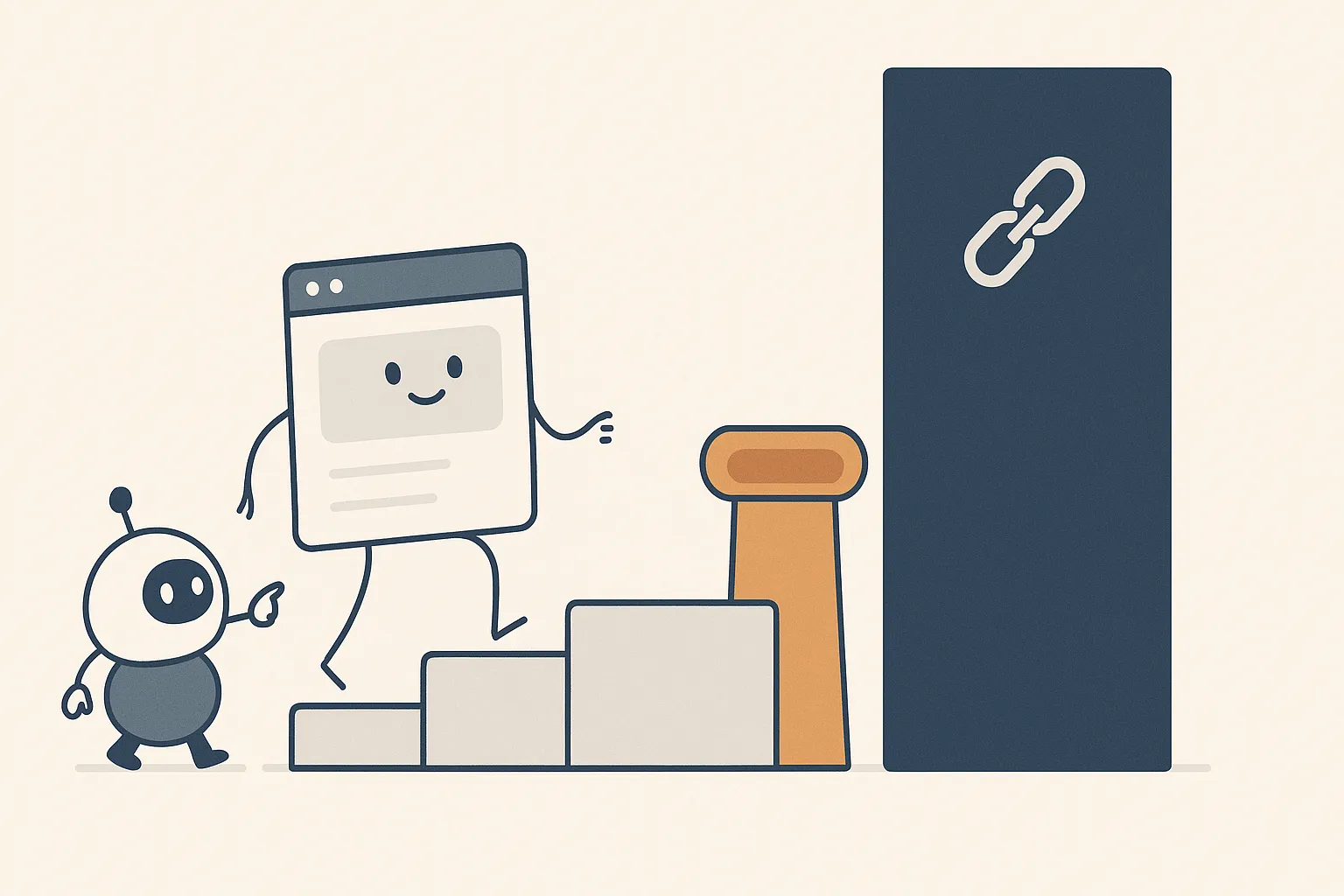
Yes, you can rank a website without backlinks, but only if you define “without backlinks” precisely. A page with no links pointing directly at it can rank. An established domain can improve rankings without running a new link-building campaign. A brand-new site with no external authority can sometimes win a narrow, weakly served query. Those are three different claims, and only the last one is truly a zero-backlink test.
Relevance gets you into the race. Authority changes which races you can win.
Backlinks are not the admission ticket to Google. They are the difficulty setting.
Can you rank without backlinks? Yes, in the right race
You can rank without acquiring new backlinks when your page is eligible for indexing, matches the searcher’s intent better than the alternatives, adds information the result set lacks, and targets a query your domain is strong enough to compete for. The weaker the competition and the more specific the need, the less external authority the page may need.
Google’s own documentation leaves room for that answer. Its SEO Starter Guide says Google uses many signals to rank content, while its ranking systems guide says PageRank, which uses links, remains part of the core ranking systems. Links matter. They are not the only input.
| Situation | Can it rank without new backlinks? | What usually decides it |
|---|---|---|
| Established domain, new page, narrow query | Often | Intent match, topical fit, internal links, information gain |
| Established domain, competitive commercial query | Sometimes | Existing authority may carry it, but strong competitors can create a link ceiling |
| New domain, specific and poorly served query | Possible | Low competition, clean indexation, unusually useful content |
| New domain, competitive head term | Unlikely | The domain has not earned enough trust to beat established alternatives |
That is why “do you need backlinks to rank?” has no universal yes or no. You need enough authority for the result set you are entering. Sometimes the site already has it. Sometimes the query barely demands it. Sometimes earning external authority is the only lever left.
The legal SaaS pages moved without a new link campaign
I saw this distinction play out on an established legal SaaS site. Twenty-nine core platform pages had been written around broad benefit language, but many never stated the bottom-of-funnel term they needed to rank for in the H1. We mapped one commercial query to each URL, made the page’s subject explicit, moved the benefit language into supporting sections, and added firsthand product evidence.
Rankings began to move without a new backlink campaign during that intervention. Across the wider platform set, 65 pages recovered indexation within five weeks.
The caveat matters. This was not a brand-new domain with zero links, and the wider program also included consolidation, schema, and bottom-of-funnel work. The result does not prove backlinks were irrelevant. It proves they were not the immediate constraint. The pages first needed to become eligible, explicit, differentiated answers to the searches they were supposed to win.
That boundary is what makes the full legal SaaS case study useful. If we had started by buying or pitching links, we would have sent more authority toward pages that still made an unclear claim.
No direct backlinks, no new backlinks, and zero authority are different
Before you decide to pursue SEO without backlinks, identify which version you actually mean.
| Claim | What it really describes | What you can conclude |
|---|---|---|
| ”This page has no backlinks” | No external links point directly to the URL | The page may still inherit authority through its domain and internal links |
| ”We did no link building” | No links were deliberately acquired during the period | Existing earned links and brand reputation still count |
| ”This domain has low authority” | Few trusted sites mention or link to the domain | Narrow queries may be available, but the competitive ceiling is lower |
| ”This site has zero external authority” | A genuinely new or isolated domain with no meaningful off-site signals | Any win is evidence about that specific weak result set, not proof that links never matter |
This is where many case studies overreach. A page-level backlink checker can show zero links to a URL while the domain has years of history, press, citations, and links feeding other pages. Internal links route some of that earned strength to the new page. They do not create external authority from nothing.
The same caution applies to traffic without backlinks. A site can earn traffic from branded searches, long-tail queries, local demand, referrals, communities, or pages supported by the domain’s existing reputation. “No new links to this page” is not the same as “no outside signal helped this site.”
When SEO without backlinks can work
SEO without backlinks is most plausible when the search result leaves room for relevance and specificity to beat raw authority. Look for these conditions together, not one at a time.
The query is specific and the intent is underserved
A narrow problem, industry, integration, comparison, or use case usually has fewer credible contenders than a head term. If the result set answers the general topic while your page can answer the exact operational question, you have a relevance advantage. That is why a low-authority site may rank a precise workflow page before it ranks a broad category guide.
The domain already has some earned trust
An established site does not start each new URL from zero. Its history, existing backlinks, known entity, and strong pages create a base that deliberate internal links can distribute. If you are asking how to rank without backlinks on a mature domain, the practical question is usually whether you need new backlinks for this page, not whether links have ever helped the site.
The page contributes information gain
The best link-light opportunity is not merely a lower-volume keyword. It is a result set you can improve. Add first-party data, a tested process, screenshots, tradeoffs, failures, or a conclusion competitors cannot reach from public summaries. Information gain gives Google a reason to keep your page in the result instead of treating it as another interchangeable explanation.
The page has a real place in the site
A strong page buried outside the site’s topic structure has to do too much alone. A page linked from a clear hub and related spokes inherits context, crawl paths, and internal authority. The surrounding cluster tells both readers and search systems that the page is part of sustained expertise, not a one-off attempt to catch a keyword.
The technical foundation is quiet
Links cannot rescue a page blocked by noindex, an incorrect canonical, a crawl rule, or a broken redirect. If the page is not being stored, diagnose why the website is not showing up on Google before you diagnose authority. Eligibility comes first.
How do backlinks help SEO?
Backlinks help SEO in three practical ways: they help search engines discover pages, they pass authority from one site to another, and they give search systems independent evidence that a source is worth trusting. The competitive value rises when several pages are equally relevant and useful. At that point, external authority can become the tie-breaker.
Google says it primarily discovers pages through links from pages it already crawled, although a sitemap can also help discovery. It also says PageRank remains part of its core ranking systems. That is the cleanest answer to “are backlinks still relevant?” Yes, while relevance, quality, usability, context, and many other systems also affect the result.
Good links can also do something a ranking report misses: put your brand inside the sources people and answer engines already trust. That is why the right objective is not a raw backlink count. It is earning relevant editorial links and mentions from credible sources in the market.
Buying or manufacturing links because a page stalled is a different proposition. Google’s spam policies explicitly call attempts to manipulate rankings with links link spam. Diagnose the constraint, then earn authority in ways that would still make sense if the link metric disappeared.
Genuinely useful content earns links without asking
Google can tell a high-quality link from a low-quality one at this point, which changes what link building should mean. Publish unique data, an original study, or a point of view nobody else can produce, and people link to it on their own. That is the durable version of link acquisition, and it runs on the same first-party evidence that helps a page compete before any outreach begins.
The gap is usually time, not merit. A brand-new site has not had the chance to accumulate that profile yet, and on-page work does not compress the wait entirely. Backlinks will always get you there faster. Treat them as an accelerant on a page that already deserves to rank, not as a substitute for deserving it.
Confirm the link is do-follow
One distinction decides whether the effort pays off: the link has to be do-follow. When you run digital PR, pay for placements, or pitch newsletters and industry sites, confirm the link passes authority before you spend anything on it. If a publication will not give you a do-follow link, you might as well not be linked at all as far as the ranking problem is concerned.
A no-follow mention is not worthless. It still puts your brand in front of readers and into the third-party source pool answer engines read, which matters for the AI-visibility problem further down this page. It just does not solve the authority ceiling, so do not accept one and record it as a win against the wrong constraint.
How to rank without backlinks: six steps before outreach
If you want to rank without backlinks, work through the SEO fundamentals you control, in order. The sequence matters because each step gives the next one a fair test.
1. Confirm the page is eligible and indexed
Inspect the URL in Search Console. Confirm Google can crawl it, the page returns a successful status, the canonical points where you intend, and no noindex or robots.txt rule blocks it. Then check whether it is indexed. Authority is not the diagnosis when the page is technically ineligible.
If the page remains crawled but excluded, improve the page and its place in the site before looking for links. Google has already found it and decided not to store it. More discovery is not what it lacks.
2. Choose a query your current authority can win
Search the term and classify the result set. Are the ranking pages direct answers to the same intent? Are they on specialist sites, giant publishers, marketplaces, or product domains? Does the query reward a blog post, landing page, tool, or comparison? Your target has to match both the intended page type and the level of competition.
When a new site faces established domains on a broad commercial term, move one level more specific. Add the industry, role, problem, integration, or decision stage. Rank without backlinks where relevance can plausibly outweigh the authority gap, then expand as the site earns trust.
3. Match the page type and make its subject explicit
Use the format the query expects and state the topic plainly in the title, H1, opening answer, and useful supporting headings. Do not bury the primary term beneath a clever brand line. The legal SaaS pages moved after the commercial query became the page’s explicit claim, not after we added more generic copy.
That does not mean repeating the keyword in every paragraph. It means removing ambiguity. A reader and a crawler should be able to identify the page’s purpose from the first screen.
4. Add information competitors cannot copy
Audit what the ranking pages already say, then add what only your business can know. Use customer questions, product data, sales-call patterns, implementation lessons, experiments, or a decision framework based on real work. This first-party data creates a content moat, and it turns “better content” from a slogan into a defensible reason to rank.
Originality is especially valuable for low-authority sites because it gives other people a reason to cite the page later. The same first-party evidence that helps a page compete before outreach can become the asset that eventually earns links.
5. Route existing authority with internal links
Link to the page from the relevant hub, related supporting articles, and at least one page Google crawls frequently. Use anchors that describe the destination. Link back from the new page into the cluster so it participates in a coherent structure.
Internal links do not replace backlinks. They decide where the authority you already have goes. A site with ten strong pages and a new orphan has an architecture problem; a site with a perfectly linked cluster and no external trust may still have an authority problem.
6. Measure the plateau before investing in links
Let Google recrawl the material changes, then watch impressions, average position, query coverage, and the domains above you. Do not use a universal waiting period. Crawl frequency, site history, query demand, and the scale of the edit all change the timeline.
If the page begins earning impressions and moves upward, keep improving relevance and evidence. If it stays outside the index, return to eligibility and value. If it settles beneath equally useful pages on better-established domains, you have found the likely authority ceiling. That is when off-page SEO becomes the next rational investment.
The backlink ceiling has a recognizable shape
You do not need to guess whether backlinks are the constraint. Look for a complete pattern.
| Check | Evidence that it is not the current problem | Evidence that authority may be the ceiling |
|---|---|---|
| Indexation | URL is excluded or canonicalized elsewhere | URL is indexed and recrawled after the changes |
| Intent | Ranking pages use a different format or answer a different job | Your page matches the dominant intent and format |
| On-page relevance | The topic is absent from the title, H1, or opening | The page makes a clear, focused claim |
| Information gain | The page repeats the same public advice | It contains useful first-party evidence or a distinct decision framework |
| Internal support | The page is an orphan or weakly linked | Relevant hubs and strong pages point to it descriptively |
| Competitive result | Your page has not begun to appear for the query | It repeatedly stalls below equally relevant pages on more trusted domains |
Do not jump to the last row while any earlier row is unresolved. Link acquisition is expensive, slow, and uncertain. Fix the page-level constraints you control first. Once those are sound, the plateau becomes meaningful rather than mysterious.
AI search raises the cost of off-site silence
A link-light SEO strategy can earn rankings and still leave a brand absent from AI-generated recommendations. In a six-account export I analyzed, 88.7% of the sources cited in AI answers came from independent third parties. Competitor domains made up 8.7%, while the brands’ own sites accounted for only 2.6%.
Those percentages are descriptive, not proof that backlinks caused the citations. They do show why publishing only on your own site creates a visibility ceiling. An answer engine building a category recommendation often looks outward for corroboration. If credible publishers, reviewers, communities, and industry sources never mention the brand, the model has little independent evidence to work with.
This is where earned media and off-page authority converge. It is also why the wider generative engine optimization system cannot stop at owned content. The goal is not to spray guest posts for link metrics. It is to become part of the independent source environment that customers and answer engines consult.
When to stop avoiding link building
Stop treating “no backlinks” as a virtue when the evidence says authority is the remaining constraint. That point usually arrives when:
- the query is commercially valuable and the ranking domains have materially stronger reputations;
- the page is indexed, intent-matched, useful, original, and well supported internally;
- rankings improved after the on-site work, then stopped at a consistent tier;
- your brand is absent from the third-party sources that shape category discovery;
- a competitor’s page is not more helpful, but the competitor is referenced across the market; or
- the site is new and needs basic independent confirmation that it exists and deserves attention.
The move is not to collect a prescribed number of links. It is to earn the kinds of citations, coverage, partnerships, and resources that close the specific trust gap. One relevant industry reference can be worth more than a hundred unrelated directory links, and it carries less risk than tactics designed only to manipulate rankings.
Rank the winnable pages first. Use those pages to prove expertise and create assets worth referencing. Then earn external authority where the competitive ceiling makes it necessary. That is a more durable strategy than pretending backlinks do not matter or treating them as the first answer to every stalled page.
FAQ
Can a new website rank without backlinks?
Yes, a new website can rank without backlinks for a sufficiently specific, low-competition, poorly served query. It is unlikely to outrank established domains for competitive head terms because it has little external authority. Treat an early long-tail win as evidence that the page fits that result set, not proof that the site will never need links.
How long does it take to rank without backlinks?
There is no universal timeline. A page on an established, frequently crawled site can begin appearing within days or weeks, while a new domain may take much longer to be discovered, indexed, evaluated, and trusted. Measure the stages separately: crawl, indexation, impressions, and position. A page that is not indexed has a different problem from one that ranks on page two.
How many backlinks do you need to rank?
There is no minimum backlink count. The requirement depends on the query, the quality and relevance of the links, the authority the domain already has, and how strong the competing pages are. A page may rank with no direct backlinks, while another may need substantial independent authority. Diagnose the result set instead of chasing a universal number.
Do internal links count as backlinks?
No. Internal links connect pages on the same domain, while backlinks come from other domains. Internal links help crawlers discover pages and route relevance and existing authority through your site. They are essential, but they cannot manufacture the independent external trust a backlink or third-party mention can provide.
Can you get traffic without backlinks?
Yes. You can get traffic without backlinks through low-competition organic queries, branded search, local discovery, communities, referrals, email, social distribution, and direct visits. For organic growth, the more competitive the query becomes, the more likely external authority will affect your ceiling.
Are backlinks still a Google ranking factor?
Links still contribute to Google’s ranking systems. Google says PageRank, which uses links, remains part of its core systems, while also making clear that Search uses many signals. The practical conclusion is not that every page needs a backlink quota. It is that links remain one source of authority among a larger set of relevance, quality, context, and usability signals.