How to Survive Google Core Updates
A Google core update moves your rankings because the quality bar moved. You can't control the algorithm, so control the controllables. The calm playbook.
A Google core update is a re-assessment of quality
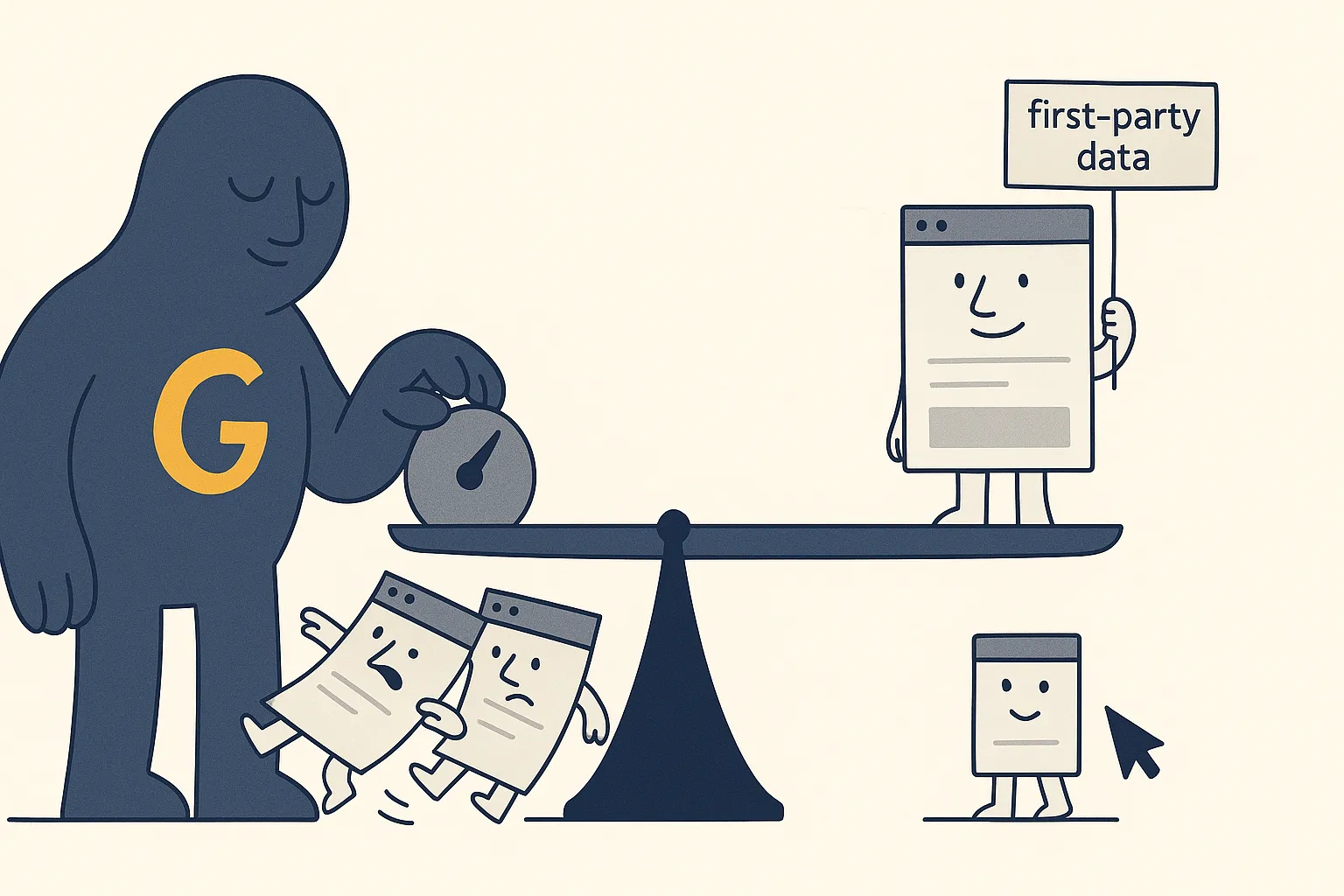
A Google core update is a broad, sitewide change to how Google assesses content quality. It is not a penalty and it is not a manual action against your site. Google’s own guidance is blunt about it: there is nothing wrong with pages that drop, they are simply being re-assessed against an improved system for rewarding helpful content. Your rankings moved because the quality bar moved.
That distinction is the whole mindset, and it decides what your SEO strategy does next. A penalty is something you fix. A re-assessment is something you respond to by being genuinely better than the pages that replaced you. If you treat a core-update drop like a penalty, you go hunting for a technical error that is not there and you miss the actual message, which is a judgment about the quality and originality of your content.
Diagnosing an update hit and planning the recovery is what my Google penalty recovery service covers.
Why your rankings moved: the whole bar moved
Core updates re-weight how Google values things, so a page that was good enough last month can sit below a competitor’s this month without either page changing a word. The volatility is real and it is broad. Google has run two broad core updates so far in 2026: the March update, which rolled out March 27 through April 8, and the more recent and more disruptive May update, which did not finish until June 2 after ranking tremors on May 23, May 30, and a final spike the day it completed. If your rankings moved in early June, that was the May update still settling.
Start with the most recent one, because it is the update shaping results right now. The May 2026 update was one of the most disruptive in recent memory, and it did not land as a single clean shock. SEMrush Sensor peaked around 7 out of 10, classed High, with mobile volatility spiking to 7.8 over May 30 and 31, and MozCast ran above 100 degrees for four straight days before readings collapsed back to about 0.9 by June 3. YMYL and aggregator sites moved first and hardest.
The March update earlier in the year is the useful comparison. Its one-day SEMrush Sensor reading actually peaked higher, around 9.5 out of 10, with roughly 55% of sites seeing shifts and about 80% of top-3 positions changing hands during the rollout.
But a higher single volatility number did not make March the bigger event. May’s impact ran broader and more sustained, across desktop and mobile and a full twelve days. That gap is the first lesson: a single reading on a volatility tracker is a tremor gauge. What happened to your site shows up in your own Search Console.
The reshuffle is not random, though, and that is the useful part. The same update had a clear pattern to who fell and who rose.
| Fell hardest | Rose |
|---|---|
| AI content farms (−60 to −90%) | Brand-owned domains |
| Affiliate sites (up to −71%) | Official and institutional sites |
| Thin comparison, aggregator, low-effort UGC | Specialist publishers |
| Pages that only synthesize what already ranks | Platforms that own their inventory |
You cannot control the algorithm, so control the controllables
Here is the part nobody wants to hear: you do not control core updates. You will go up or you will go down, and you cannot dictate the algorithm. Chasing each update, trying to reverse-engineer the exact knob that moved, is a losing game that keeps you in permanent reaction mode. The only durable move is to control the controllables.
You can’t control the algorithm. You can control whether your content is the kind that survives every version of it.
The controllables are the same short list every time, and they are exactly what core updates keep rewarding:
- First-party data. Proprietary numbers, customer outcomes, original benchmarks. Stats borrowed from Gallup, SHRM, or McKinsey are commodity data anyone can cite. The first-party data you own is the moat that a re-assessment cannot filter out.
- A defensible point of view. Pages that carry a real perspective survive; pages that restate the consensus get filtered before they compete.
- Information Gain. If a page adds nothing not already on the pages ranking above it, Google increasingly declines to show it. That is the same quality reset behind crawled, currently not indexed.
- Real E-E-A-T. Genuine experience and expertise, shown not claimed. This is what E-E-A-T actually means for B2B SaaS, and it is a filter core updates lean on.
- Intent match. The page has to be the best answer to the actual query, in the format the searcher wants.
Build on those and core updates stop being a threat and start being a sorting mechanism that works in your favor.
Do not overreact: separate a real drop from noise
The most expensive mistake after a core update is panicking at noise. Not every dip is the update, and not every dip needs a response, and a true drop can also have nothing to do with a core update at all, which is the wider question of why your website is not showing up on Google. Part of my job on every account is telling a nervous stakeholder the difference between a signal and a swing.
A real example of the calm read: on a legal SaaS account, a November dip looked alarming until you lined it up against the calendar. It was consistent with seasonal demand patterns, and the right call was to keep doing the work and leave the pages alone. The account finished the year ahead. On another account during a noisy rollout, none of the client’s priority keywords were actually impacted, so the recommendation was to monitor Search Console for volatility and take no action. Sitting still is a strategy when the data says the drop is not yours.
Before you conclude a core update hurt you, rule out three things: seasonality, instrumentation changes like the removal of the num=100 parameter that altered how impressions are counted, and simple tracking artifacts. Most of what looks like a catastrophe in week one settles by week three. Act on the trend.
A dip right after you make changes can be the rank-transition filter
There is a related pattern worth understanding, because it is the calm thesis in miniature and it trips people up constantly. When you make changes to a site, especially quick or sweeping ones, your rankings can drop before they rise. That is not always a sign the change was wrong. It is, at least in part, a deliberate mechanism.
Google’s own patents describe a rank transition function: a system that can dampen or temporarily shift a page’s ranking after a significant change before rewarding it, and the 2024 leak of Google’s internal ranking documentation reinforced that behavioral and re-ranking signals are baked into how results are scored. The stated logic is anti-manipulation. If someone games the algorithm with bought links, keyword stuffing, or a sudden overhaul, they are expecting an instant payoff. When Google delays or reverses the effect instead, the manipulator panics: they rip the changes back out, pile on more fake signals, and thrash around trying to force it. That thrashing is the tell. It is how the system separates a spammer chasing a quick win from a legitimate operator making a real improvement.
The textbook shape is a drop of ten to thirty positions after an optimization, followed by a slow climb back and beyond over the following weeks. If you see that, the worst thing you can do is exactly what the manipulator does: panic and reverse course. The reversal throws away a legitimate change and imitates the behavior the filter is built to catch.
The single worst response to a post-change dip is to undo the change. Patience is the difference between a real improvement and a manipulation attempt, and the algorithm is watching which one you are.
This is the same discipline as not overreacting to a core update, applied at the page level. Make changes for real reasons, give them time to settle, and do not mistake a transition for a verdict. It is also why you test before you scale: roll a change out on a subset, let it move through its transition, and confirm the direction before you commit the whole site to it.
What to do when a Google core update hits
When a drop is real, the recovery playbook is disciplined:
- Confirm it is actually the update. Line the rollout dates up against your drop and rule out seasonality and instrumentation first. Compare like-for-like periods in Search Console before you conclude anything.
- Diagnose by intent and page type. Segment the loss. Thin top-of-funnel pages behave differently from bottom-of-funnel commercial pages. Which kind lost tells you whether this is a quality reset or a demand shift.
- Do not make sudden sitewide changes. Panic edits cause their own regressions. On one creator-tools account, a sweeping header change during a refresh hurt rankings on its own, independent of any update, a clean lesson in holding structure steady while you assess.
- Rebuild on the controllables. Strengthen the pages worth saving with first-party data, a point of view, Information Gain, real experience, and tight intent match. Prune or consolidate the thin pages that only synthesized what already ranked.
- Test before you scale, then monitor. Roll changes out on a test set first. If the test pages beat the control, scale. If they regress, revert and reassess. Then watch Search Console for sustained movement and ignore daily swings.
Proof it works: growing through the update
Controlling the controllables is not a feel-good slogan. It shows up in the data, and it shows up most clearly when the ground is moving. Through the volatile 2026 core updates, a cybersecurity SaaS account I work in ran a hub-and-spoke content rebuild on its foundational topic area, built on exactly the durable stuff above. While roughly 80% of top-3 positions industry-wide were being reshuffled, that section’s top-3 keywords grew from 374 to 818, and its top-10 keywords from 1,261 to 2,086, climbing straight through the updates.
The same pattern held on an observability account, where a clean, first-party-backed content program produced an early read that improved through a core update. Neither result came from predicting the algorithm. Both came from building the kind of content the algorithm keeps rewarding, and then not flinching when the front page shook. That is the whole strategy. Don’t manage to the volatile ranking line. Build the durable asset and let the updates sort in your favor.
Google core update FAQ
How to recover from a Google core update?
The short answer on how to recover from Google core update drops: you recover by improving the content, because there is no penalty to reverse. Confirm the drop is real and not seasonality or an instrumentation change, diagnose which page types and intents lost, avoid sudden sitewide edits, and rebuild the pages worth saving with first-party data, a defensible point of view, Information Gain, real experience signals, and tight intent match. Prune or consolidate thin pages that only synthesized what already ranked. Then test changes on a subset before scaling. Recovery follows genuine quality improvement.
How long does it take to recover from a Google core update?
Often not until the next core update, though partial recovery can come sooner as Google re-crawls and re-assesses improved pages. Google has historically noted that a site significantly affected may not fully recover until a subsequent update, which can be weeks or months out. The practical takeaway is to make real improvements now and keep monitoring, and expect recovery to take until the next re-assessment. Judge progress on the trend across the next re-assessment.
How often does Google release core updates?
Google rolls out broad core updates several times a year, with additional targeted and system updates in between. In 2026 there were two by mid-year: the March update (March 27 to April 8) and the May update (May 21 to June 2), only about six weeks apart, a faster cadence than the three-to-four-month spacing that had been typical, with the next broad update expected in the second half of the year. Each rollout usually takes roughly one to two weeks to fully deploy, which is why early volatility often settles before the update finishes. Because they are frequent and unpredictable in timing, the durable strategy is to build content that survives any of them.
How do I find the latest Google core update?
Google logs every confirmed update on its Search Status Dashboard, which doubles as the official Google core update history, and Search Engine Land and Search Engine Roundtable track them in near real time with rollout dates and volatility notes. For the latest, the two Google core update 2026 rollouts to know are the March and May updates. That is where you confirm whether a ranking swing lines up with a live update. Knowing the name and date changes little about what you do, though: the response to any core update is the same durable playbook above.
Why should you care about core updates?
Because a single rollout can swing your organic pipeline before you change a thing, and the swing is not random. The 2026 core updates reshuffled roughly 80% of top-3 positions, and the pattern held: AI content farms and thin aggregators fell 60 to 90%, while brand-owned domains and specialist publishers with first-party proof rose. If your growth leans on organic and AI-answer visibility, each update is the moment the quality bar resets and your competitors’ rankings are up for grabs in both directions. You cannot control it, so caring means building the pages that survive it, first-party data, a real point of view, and tight intent match, before the next one lands.
How do you prepare for a Google core update?
You prepare for a core update before one is announced, and you prepare for all of them the same way, because there is no update-specific checklist to run the week it lands. The preparation is the controllables: first-party data, a defensible point of view, Information Gain, real E-E-A-T, and tight intent match, built into your pages while the SERP is calm. Sites that already carry the thing only they have tend to hold or gain when the bar moves; sites padded with content that only synthesizes what already ranks are the ones sorted out. So the honest “tip” is to stop preparing for the next update and start building pages that survive any of them.
What changed
- September 29, 2026: Tightened the writing throughout and linked the related service page.