Local SEO for Lawyers: The 2026 Playbook
Local SEO for lawyers, from Google Business Profile and reviews to location pages, intake, and signed-case reporting.
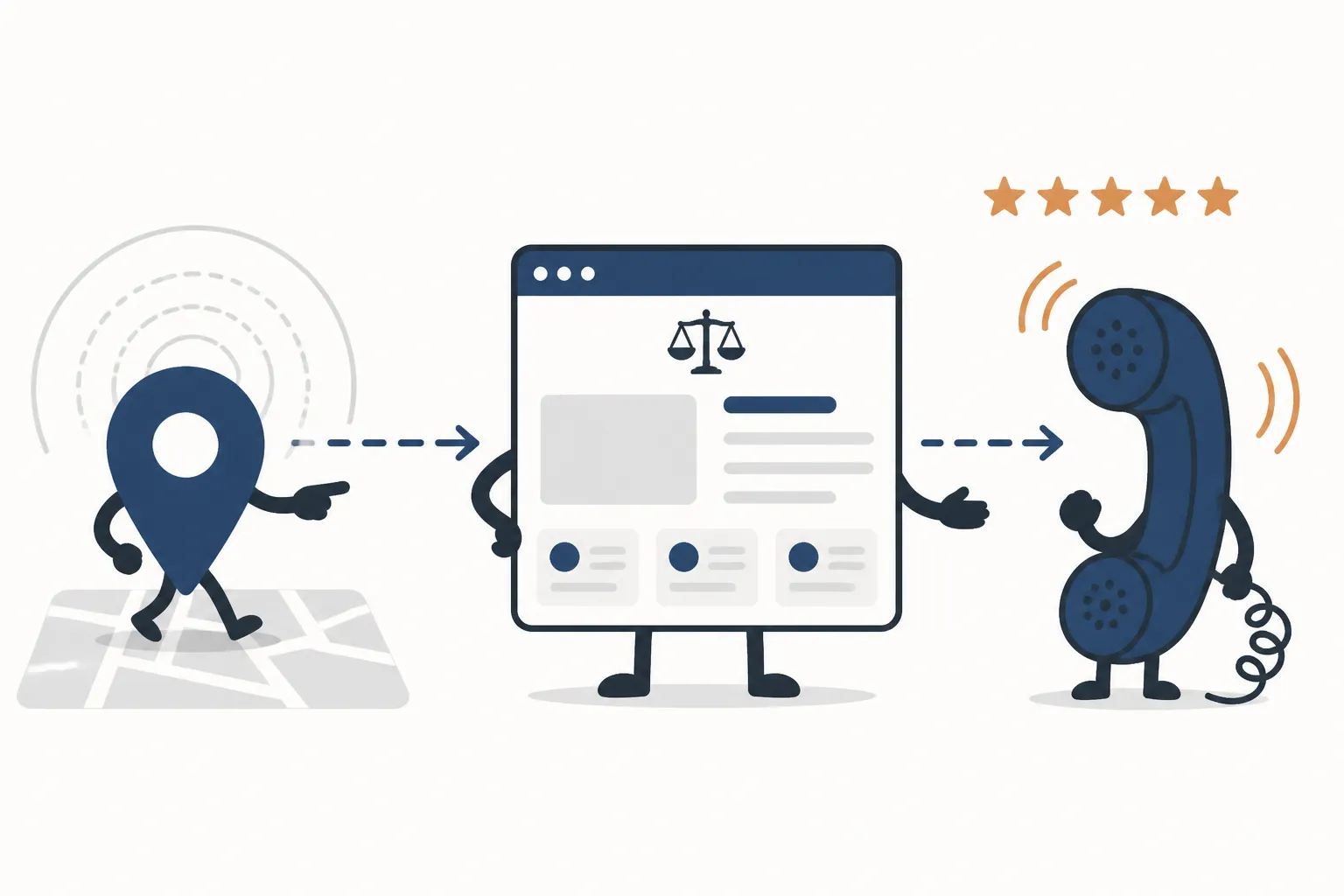
Local SEO for lawyers means making a law firm eligible, relevant, and trustworthy when someone nearby searches for a specific kind of legal help. The work connects Google Business Profile, Google Maps, practice-area pages, office-location pages, reviews, legal directories, technical SEO, and intake measurement. A pin in the Google Maps local pack is one output of that system.
The order matters. A firm can have a polished profile and still send every visitor to a generic homepage. It can publish 40 city pages and still have no legitimate office in 39 of them. It can earn calls and still lose the matters because intake takes two days to respond. Local visibility only becomes growth when the search, page, proof, and response experience agree.
This guide covers marketing operations. It is not legal or ethics advice. Lawyer-advertising, testimonial, specialization, solicitation, and intake rules vary by jurisdiction. The responsible lawyer should review the firm’s applicable rules and every material public claim.
Audits, costs, providers, reporting, and program ownership for every kind of business sit in the SEO services hub.
How does local SEO work for law firms?
Local SEO for law firms works across two Google surfaces: the local results tied to Business Profiles and the standard organic pages beneath them. AI answers are a fast-growing third surface: BrightLocal’s 2026 survey of 1,002 US adults found that use of ChatGPT and other generative AI tools for local business recommendations rose from 6% to 45% in a year, making AI the third most popular source of recommendations. A potential client may move between the map result, firm website, attorney bio, reviews, and a legal directory before calling. Treating those as unrelated channels makes the reporting wrong and the experience inconsistent.
Google names three factors that determine local ranking: relevance, distance, and prominence.
| Local factor | What it means | What a law firm can do |
|---|---|---|
| Relevance | How well the profile matches what the person searched | Choose accurate categories, complete the profile, connect the right practice-area pages, and make services clear |
| Distance | How far the result is from the location in or inferred from the search | Maintain accurate real offices and service information; do not create fake locations |
| Prominence | How well-known and well-supported the firm appears across the web and real world | Earn genuine reviews, links, directory profiles, press, professional mentions, and strong organic visibility |
Distance is the constraint no profile edit can change. You can improve relevance and prominence. You cannot add a keyword to a profile and make an office physically closer to a searcher. That is why a firm should track local rankings from representative points around each real market.
Google states it directly: “There’s no way to request or pay for a better local ranking on Google.” Paid ads buy separate, labeled placements. Anyone selling a guaranteed top-three map ranking is making a promise the platform does not support.
Local and consumer-facing search programs like this fall under my B2C SEO services.
How do you do local SEO for lawyers?
Local SEO for lawyers runs as an eight-step sequence, and the order is the strategy: finish identity and ownership before expanding pages, build real pages before chasing links, and fix intake tracking before reporting a return. The strongest local SEO for law firms programs follow it step by step.
1. Confirm Business Profile ownership and eligibility
Put the firm in control of every eligible Google Business Profile before changing categories, names, or landing pages. The firm should be the owner, with an agency or consultant added as a manager. Keep verification records, the account inventory, and recovery access somewhere the business controls.
Then audit every existing profile:
- Which firm profiles represent a real, staffed office where clients can meet the business?
- Which profiles are duplicates, former locations, or ineligible virtual offices?
- Which public-facing lawyers have practitioner profiles?
- Which phone number and website page does each profile use?
- Do the real-world firm name, signage, website, and profile agree?
Google’s representation guidelines explicitly include lawyers as individual practitioners. A lawyer should have a dedicated practitioner profile only when the lawyer is public-facing and can be contacted directly at the verified location during stated hours. A practitioner should not create multiple profiles for multiple specializations.
If several public-facing lawyers work at one office, the organization may have its own profile and qualifying practitioners may have separate profiles. The practitioner profile should use the lawyer’s own name. If one lawyer is the only public-facing practitioner at a branded organization, Google recommends sharing one profile using the brand and practitioner naming format.
Do not improvise here. Duplicate profiles can split reviews and confuse ownership. Ineligible offices and keyword-stuffed names can trigger edits or suspensions. A law firm local SEO program built on profiles the firm cannot defend is carrying operational debt from day one.
2. Complete the law firm’s Google Business Profile
Complete each eligible profile with the real-world business name, the most specific accurate primary category, limited relevant secondary categories, current hours, a local phone number, the right website landing page, services, and current photos. Accuracy comes before keyword coverage.
The primary category is a real strategy decision because it tells Google what the office principally is. Choose the category that best describes the primary practice represented by that profile. Do not add every vaguely related legal category to make the listing look comprehensive. Google’s guidance says to use the fewest categories needed to describe the core business.
Match the destination page to the profile. A single-office firm may reasonably use a strong homepage or office page. A multi-location firm should usually send each location profile to its corresponding location page, with no tracking URL masking the destination.
Use call tracking carefully. The profile should retain a stable, firm-controlled primary number that connects to the location. If a tracking number is used, preserve the real local number as an additional number and make sure the tracking provider cannot become the owner of the firm’s phone identity.
Business descriptions should explain the firm, services, and market in plain language. Do not add promotional claims, links, or a string of city and practice keywords. Add current office and team photos that help a prospective client recognize the location and people. Posting can support freshness and conversion, but Google does not document a required posting frequency as a local ranking factor. Daily posting is not a prerequisite for competent attorney SEO.
3. Map practice-area and location demand
Create a query-to-page matrix before writing. The matrix should show the practice area, geographic modifier, search intent, map-pack presence, current ranking URL, intended URL, office or service relationship, conversion action, and responsible subject-matter reviewer.
| Search pattern | Likely surface | Intended destination |
|---|---|---|
[practice area] lawyer near me | Map pack plus organic | Eligible office profile and the closest strong practice page |
[practice area] lawyer [city] | Map pack plus localized organic | A relevant practice-area or location-practice page with real market substance |
[firm name] reviews | Brand result, profile, review platforms | Accurate profile, review presence, and reputation response |
[lawyer name] [practice] | Practitioner and organic bio results | Eligible practitioner profile and a complete attorney bio |
[legal problem] in [state] | Primarily organic and answer surfaces | Attorney-reviewed informational or service content |
The matrix exposes two expensive mistakes. The first is one generic “services” page competing for every practice. The second is creating every possible practice-area and city combination even when the firm has no distinct relevance or evidence for the page.
Use live search results to decide whether a query deserves a location page, a practice page, a guide, or no new page. Check whether the map pack appears, which page types rank, and whether the current site already has a URL Google prefers. The process behind keyword research for SEO applies, but the local grid and profile relationship add another layer.
4. Build useful practice-area and location pages
Build one useful page per real office or genuinely distinct market need. The page should help a potential client decide whether the firm handles the problem, serves the location, and is credible enough to contact. Swapping a city name into the same 700 words does none of those jobs.
A strong law-firm location page can include:
- the office’s real address, phone, hours, accessibility, parking, and directions;
- the lawyers who actually work with clients from that office;
- the practice areas available there, linked to substantive practice pages;
- jurisdiction-specific information reviewed by a responsible lawyer;
- representative experience or outcomes presented within applicable rules;
- genuine testimonials or reviews the firm is allowed to use;
- local professional, civic, court, or community context that is actually relevant;
- a short, clear path to call or request a consultation;
- a warning not to submit confidential or time-sensitive details through an unsecured general form.
Avoid the travel-guide filler that appears in some location-page templates. A history of the city or a list of nearby restaurants does not prove legal relevance. Directions, courthouse context, jurisdiction, local procedures, office access, responsible attorneys, and the firm’s real work are more useful.
The same rule applies to SEO for law firm websites with multiple offices: pages need unique facts because the operations are unique. If the firm cannot explain what differs about its presence, people, service, or jurisdiction in a market, it may not have earned a separate page.
Connect the architecture intentionally. The main practice page should link to relevant offices. Each office should link to the practices actually handled there. Attorney bios should link to their practice and office pages. Those links help a prospective client navigate and help search engines understand the same relationships. My internal-linking guide covers the mechanics.
5. Create a compliant review system
Ask clients for honest reviews through a consistent process that the responsible lawyer has approved. Google allows businesses to share a review link or QR code, but prohibits incentives for posting, changing, or removing reviews. Do not offer a discount, gift, donation, or other benefit in exchange for a review.
Do not review-gate, either. Sending only satisfied clients to Google while diverting unhappy clients to a private form manipulates the sample and can create policy and trust problems. Ask eligible clients consistently at a sensible point in the relationship, without scripting the sentiment.
Law firms carry an additional confidentiality constraint. A public response that confirms someone was a client, names a matter, corrects the person’s version of events, or reveals a result can create a bigger problem than the negative review. Use a short, approved response library that thanks the reviewer or acknowledges feedback without confirming representation or discussing facts. Escalate unusual reviews to the responsible lawyer.
Google says “more reviews and positive ratings can help your business’s local ranking.” Reviews also decide whether a searcher trusts the listing enough to click or call: BrightLocal’s 2026 consumer survey found that 97% of consumers read reviews for local businesses. Track request rate, review rate, rating distribution, response time, and policy removals. Never make “five stars only” the operating goal.
6. Clean citations and build local authority
Correct the firm’s name, address, phone, website, and office status across the few sources people and search engines actually use. Start with major data platforms, state and local bar profiles where applicable, established legal directories, local business directories, and professional organizations. Do not buy hundreds of low-quality directory submissions because a package calls them citations.
NAP consistency is an identity-control task. The NAP errors that do damage are conflicting names, old offices, dead numbers, duplicate profiles, and URLs that point to the wrong market. Minor formatting differences such as “Suite” and “Ste.” are low priority. Keep a source-of-truth sheet for every office and practitioner profile, then record logins, owners, correction status, and last verification date.
Prominence grows from the firm’s real-world authority reflected online. Useful sources can include bar associations, chambers, local news, universities, nonprofits, professional groups, event sites, and community organizations where the firm genuinely participates. The link is valuable because the relationship and mention are real.
The same standard applies to local digital PR. Provide useful commentary on a legal change, publish attorney-reviewed data, support a community program, teach a public seminar, or make an expert available to a local reporter. Do not manufacture a press release about a new logo and call it authority. My guide to backlinks and digital PR explains the difference.
7. Fix technical SEO and structured data
Technical SEO for a law firm makes every important practice, location, and attorney page crawlable, canonical, fast, mobile-friendly, and reachable through internal links. Technical cleanup is especially important after firm mergers, rebrands, attorney departures, office moves, or a redesign because those changes affect identities and URLs at the same time.
At minimum, verify:
- one canonical URL for each office, practice, and attorney entity;
- redirects from former office, attorney, and campaign URLs to the closest honest destination;
- no accidental
noindex, robots block, or canonical to another city page; - current XML sitemaps and Search Console ownership;
- mobile call buttons and forms that work without hiding required context;
- titles and H1s that state the practice and market without false superlatives;
- fast, stable templates for location and practice pages;
- a clear 404 and removal process for departed attorneys and closed offices.
Structured data can reinforce the facts already visible on the page. Google’s LocalBusiness documentation supports identity, address, phone, hours, geo coordinates, departments, and related details. Use truthful Organization and LocalBusiness properties, with the most appropriate supported subtype, and connect attorney Person entities where the site presents them.
Do not add self-serving review stars to the firm’s own organization markup and promise a rich result. Google says the aggregate-rating property for LocalBusiness is for sites that capture reviews about other local businesses. Do not promise that LegalService or any other schema type independently raises map-pack positions. Schema helps machines understand consistent facts. Eligibility, relevance, prominence, and content still decide the ranking. The full implementation standard is in my schema markup guide.
8. Connect visibility to intake and signed cases
Track the complete path from local discovery to retained matter. Use separate source definitions for Google Business Profile and standard organic search, then preserve the original landing page and location where possible.
| Layer | Measures | Decision it supports |
|---|---|---|
| Visibility | Local-grid coverage, map-pack appearances, organic rankings, impressions | Is the firm becoming eligible and competitive for the intended market? |
| Engagement | Profile calls, website clicks, directions, organic sessions, page engagement | Are searchers choosing the result and reaching the right experience? |
| Intake | Calls answered, forms received, response time, consultations booked | Can the firm convert the demand it earned? |
| Qualification | Practice fit, jurisdiction fit, conflict outcome, consultation quality | Is SEO attracting matters the firm can serve? |
| Business | Retained matters, signed-case rate, estimated or realized value | Is the program worth continuing and where should budget move? |
Use call tracking and CRM fields that respect applicable privacy, consent, confidentiality, and record-handling requirements. A marketing dashboard does not need case facts. It needs enough controlled classification to distinguish a missed call from a qualified consultation and a signed matter.
This is where law firm SEO services often lose the plot. The report celebrates a number-one ranking while the intake team labels half the calls wrong-practice or out-of-state. Put marketing and intake in the same monthly review. Listen for routing problems, slow callbacks, confusing page promises, and markets that produce attention with poor practice fit.
What website architecture does a law firm need for one office or several?
A single-office law firm website needs a clean relationship among the homepage, practice-area pages, attorney bios, resources, and one strong office page. A multi-location firm needs the same system repeated only where the organization has a legitimate presence and distinct user need.
| Firm model | Recommended architecture | Common failure |
|---|---|---|
| Solo lawyer, one office | Homepage, focused practice pages, one attorney bio, one office/contact page, useful resources | A practitioner profile and firm profile compete even though Google recommends one shared profile |
| Multiple lawyers, one office | Firm profile, qualifying practitioner profiles, practice pages, bios, one office page | Every attorney profile points to the homepage and gives Google no distinct entity relationship |
| Multiple offices | One page per real office, practice pages, office-practice connections, relevant practitioner bios | City pages exist for markets with no staffed office or unique value |
| Statewide service without offices everywhere | Strong practice and jurisdiction content, honest service language, profiles only for eligible offices | Virtual offices and doorway pages are used to simulate proximity |
Do not create a page for every city merely because the firm can accept a matter there. Google can rank a strong regional or state resource when it best answers the query. A thinner page for every suburb can dilute internal links, duplicate claims, confuse canonical selection, and create a maintenance obligation the firm will not meet.
The matrix should have one intended owner per query cluster. If both /family-law/denver/ and /denver-family-lawyer/ target the same demand, choose one. If an office page and practice page serve different intent, make that difference obvious in the content and internal links.
Legal advertising and intake rules belong inside local SEO
Every title, profile description, review response, attorney bio, result claim, and consultation form is a public communication about the firm. The marketing team cannot treat ethics review as the last approval after the claims and templates are already built.
ABA Model Rule 7.2 permits communications about a lawyer’s services through media, but it also limits recommendations and specialization claims and requires identifying information for a responsible lawyer or law firm. Rule 1.18 addresses duties to prospective clients. Those are model rules. The firm’s jurisdiction controls, and local requirements may be more specific.
Build a review checklist into publishing:
- Are “best,” “top,” “specialist,” “expert,” and outcome claims permitted and substantiated?
- Does the page identify the responsible lawyer or firm and required contact details?
- Are testimonials, past results, disclaimers, and comparative claims presented as required?
- Does translated content receive substantive legal review as well as language review?
- Does the form warn people not to send confidential or time-sensitive facts before review?
- Are chat, SMS, call recording, retargeting, and lead-sharing practices approved for the jurisdiction and data involved?
- Can a negative-review response be published without confirming a relationship or revealing information?
The responsible lawyer gets the final word on every claim.
Does SEO work for law firms?
SEO works for law firms when search demand matches the firm’s practice and geography, the site and profile earn the click, intake responds, and the measurement reaches qualified consultations and retained matters. It works poorly when a firm buys rankings without fixing eligibility, pages, proof, or response time.
My clearest first-party local-search evidence comes from another location-dependent business. For a national swim-school brand, I worked on a program combining a full website redesign, Google Business Profile optimization, local SEO, and schema. Organic traffic increased 12% year over year, keyword rankings increased 60%, and SERP-result visibility increased 56%.
That is a multi-variable result and a different vertical. It does not promise a law firm the same lift. It does show why profile work, site architecture, structured data, and conversion experience should not be sold as disconnected line items.
I also run organic measurement for a vertical SaaS serving law firms. A combined consolidation, platform, schema, and BOFU content program made organic the largest influenced-demo channel: 362 organic-influenced demos in six months, 29% of all influenced demos, with $162.9K in influenced pipeline. A software demo is not a signed legal matter, but the reporting principle transfers: carry the reporting through to the commercial outcome. The intervention and attribution limits are documented in the legal SaaS case study.
How much should I pay for local SEO?
A monthly local SEO retainer for a law firm typically costs about $500 to $5,000. The low end buys a single-office package of Google Business Profile management, citations, and review work; the high end buys a multi-office program with location pages, attorney bios, content, and link building. Pay for the narrowest scope that solves the firm’s actual constraint and reaches implementation.
SE Ranking’s 2024 survey of 260 agencies with Duda found $500 to $1,000 a month the most popular retainer, with 64% of agencies charging below $1,000. Across the published prices of 89 SEO agencies I scored, the median monthly floor is $4,000, and agencies that sell to local and small businesses are the most likely to show a price before a sales call. A one-office firm with an accurate site may need a bounded profile, review, citation, and page project. A competitive multi-location practice may need an ongoing program across technical SEO, content, local listings, authority, CRO, and intake reporting.
Price should follow workload:
- number of eligible offices and practitioner profiles;
- number and competitiveness of practice areas;
- current site quality and migration history;
- location-page and attorney-bio work;
- review and citation cleanup;
- content and legal-review capacity;
- development and analytics implementation;
- local-grid tracking and intake attribution;
- authority and digital PR work.
Do not compare a $500 listing package with a $5,000 program as if one company simply charges 10 times more for the same work. Normalize the deliverables, senior ownership, implementation responsibility, and reporting. My SEO cost guide explains the broader pricing models.
A firm searching for lawyer SEO services should also price its own implementation and review time. If attorneys take three weeks to approve a practice page, nobody owns profile access, and the web vendor charges separately for every change, the retainer is not the full cost.
What should a law firm’s first 90 days of local SEO include?
A law firm’s first 90 days of local SEO should establish the operating system and ship the first high-impact work: profile ownership, a NAP source of truth, an intake baseline, the query-to-page map, and the first page and profile fixes. It should not promise the final map position or signed-case count on a fixed date.
| Period | Priority | Required evidence |
|---|---|---|
| Days 1–30 | Profile ownership and eligibility, NAP source of truth, analytics and intake baseline, query-to-page map, technical diagnosis | Access register, profile inventory, baseline, issue backlog, measurement definitions, responsible reviewers |
| Days 31–60 | Highest-impact profile fixes, core practice and office pages, citation corrections, review workflow, conversion tracking | Shipped changes, QA record, review process, call/form source validation, blocked-work list |
| Days 61–90 | Second page and technical wave, local authority plan, early grid/indexing read, intake-quality review | Leading indicators, qualified-intake sample, next-quarter allocation, stop/start/continue decision |
At day 90, evaluate implementation speed as carefully as rankings. A sound recommendation that never reaches the site cannot move results. A profile edit stuck in verification may need operational escalation. A surge of calls with poor jurisdiction fit may require page and category correction before more traffic.
Should a law firm do local SEO itself or hire lawyer SEO services?
A solo or small law firm can do local SEO itself if one person owns the work and the website is manageable. Claiming the profile, fixing the identity data, improving core pages, asking for genuine reviews, and installing basic call and form tracking do not inherently require an agency.
Hire outside help when the problem crosses several systems, the market is competitive, or nobody internal can execute consistently. The provider might be a consultant, freelancer, local specialist, or broader law firm SEO services team. The right model depends on whether the constraint is judgment, production, technical implementation, or ongoing ownership.
Before hiring, ask the provider to audit one market and explain:
- which queries trigger maps and which do not;
- why the current profile and page are or are not relevant;
- whether every profile and location is eligible;
- which practice/location pages should exist and which should not;
- how reviews will be requested without incentives or confidentiality risk;
- who implements site changes;
- how qualified consultations and retained matters will be reported;
- how the firm retains ownership of profiles, analytics, content, and call numbers.
Use my SEO agency selection guide for the full diligence process. The small-business SEO company shortlist scores providers on operating fit. My local SEO agencies list scores local specialists, one of which publishes a law firm case study.
What local SEO mistakes should law firms avoid?
Law firms should avoid the local SEO mistakes that turn a business identity problem into a checklist, which is where most weak local SEO tips for lawyers lead:
- creating a profile for every practice area or an office nobody staffs;
- adding keywords to the Business Profile name that are not part of the real-world firm name;
- building dozens of city-swapped pages with no distinct legal, office, or community substance;
- making every office and practitioner profile point to the homepage;
- buying bulk reviews, offering incentives, or asking only selected happy clients;
- responding to a review with matter facts or confirmation of representation;
- using “specialist,” “best,” guaranteed-result, or comparative claims without responsible review;
- changing profile categories, names, and addresses repeatedly without keeping evidence;
- adding schema that contradicts the visible page or expecting markup to create rankings;
- reporting map rankings without calls, qualification, response time, or retained matters;
- letting an agency own the Business Profile, tracking numbers, analytics, or content;
- treating all organic traffic as local intent.
The best fix is usually fewer, stronger entities: real profiles, real offices, clear practice pages, complete attorney bios, genuine reviews, defensible authority, and a measured intake path.
Local SEO for lawyers FAQ
How do lawyers rank in Google Maps?
Lawyers improve Google Maps visibility by maintaining eligible and accurate Business Profiles, choosing relevant categories, connecting useful local pages, earning genuine reviews and prominent web mentions, and strengthening standard organic visibility. Google describes the core system as relevance, distance, and prominence. A firm can improve relevance and prominence but cannot optimize away the searcher’s distance.
Can lawyers ask clients for Google reviews?
Yes, lawyers can ask clients for Google reviews. Google permits businesses to ask for genuine reviews and provide a review link or QR code, but it prohibits incentives for posting, changing, or removing reviews. Lawyers also need a responsible process for confidentiality, testimonial rules, and public responses under their applicable professional-conduct rules. Do not review-gate or script only positive sentiment.
What should a law firm Google Business Profile include?
A law firm Google Business Profile should include the real-world firm name, accurate address or service information, current hours, a firm-controlled local phone number, the right website page, the most specific accurate primary category, limited relevant secondary categories, services, and current photos. Ownership should remain with the firm, and every office or practitioner profile must meet Google’s eligibility rules.
How long does local SEO take for law firms?
Local SEO for a law firm takes 30 to 90 days to correct ownership, eligibility, measurement, priority pages, and technical problems, then several more months for competitive visibility and qualified-intake patterns to develop. Timing depends on market competition, office location, site history, review profile, authority, and implementation speed. No provider can guarantee Google’s map position on a fixed date, and Google’s own guidance says “No one can guarantee a #1 ranking on Google.”
Is SEO worth it for small law firms?
SEO is worth it for a small law firm when local people search for its practice areas, the firm has a defensible location and offer, intake can respond, and the budget can support several months of implementation. A bounded local setup or audit may be a better first purchase than a broad retainer when the site is small or the firm has not yet measured lead quality. My guide to whether paying for SEO is worth it provides the full decision model.
Does schema markup help law firm local SEO?
Schema markup helps search engines understand the firm’s visible identity, offices, attorneys, hours, phone numbers, and page relationships. It does not independently guarantee a map-pack ranking. Use truthful Organization, LocalBusiness, and Person data that matches the page, follow Google’s supported properties, and test the markup after deployment.
Is attorney SEO different from local SEO for lawyers?
Yes. Attorney SEO is the broader discipline covering technical SEO, practice-area content, links, authority, conversions, and national or informational visibility. Local SEO concentrates on geographically constrained discovery through Business Profiles, maps, reviews, citations, office and practitioner entities, and localized pages. A local firm needs both layers to work together.
The durable local SEO program for lawyers is the one where Google can verify the firm, the searcher can understand the fit, intake responds, and the business can trace visibility to matters it was built to serve.